


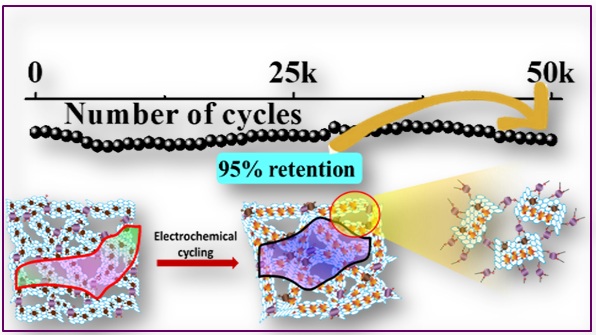
PIB News Update:Scientists at the Institute of Nano Science and Technology (INST), Mohali, an autonomous institute under the Department of Science & Technology, Govt. of India, have developed a stable material for pseudocapacitors or supercapacitors which store electrical energy by electron charge transfer. The material can offer a low-cost scalable energy storage solution as an alternative to batteries.
Dr. Ramendra Sundar Dey and his team from INST have formulated an interesting synthetic strategy to overcome the long-standing challenges of pseudocapacitors, their cycling stability, and rate capability. Pseudocapacitors are a type of supercapacitors which store electrical energy by electron charge transfer.
The team has developed the pseudocapacitive material, a hybrid xerogel structure (a solid formed from a gel by drying with unhindered shrinkage), for the very first time. The hybrid material was fabricated by the integration of a well-known organic molecule, dopamine onto a conductive matrix, like graphene. This class of xerogel architectures, although reported in the literature as alternatives to conventional pseudocapacitors, lack sufficient cycling stability to replace batteries in the consumer market.
The researchers, who investigated the reason behind performance degradation of the active materials during long service hours, offered a novel synthetic approach and then correlated it to the overall performance of the material with detailed mechanistic explanation and theoretical support provided by Dr. Abir De Sarkar from the same institute.
The pseudocapacitive material, an organic-inorganic hybrid xerogel, shows great promise as a low-cost and scalable energy storage solution for commercial applications. The INST team proposed that the method can serve as a universal approach and as a model system for organic-inorganic hybrid xerogel pseudocapacitors. The results have recently been published in the Journal of Material Chemistry A, 2020, DOI: 10.1039/d0ta02477e (I.F: 10.733).
The scientists invented the pseudocapacitive material through a unique two-step synthesis procedure that is tailored accordingly to take maximum structural advantages of the hybrid material. First, they followed a quintessential hydrothermal synthesis method for the anchoring of the redox moiety on the carbon support. However, they introduced a unique in situ electrochemical polymerization approach, in the second step of the synthesis, in an attempt to boost the overall storage capacity as well as cycling stability. As a proof of concept, to endorse the development of the self-supported smart electronics, the group fabricated an all-solid-state supercapacitor with this active material and a tandem configuration of the devices to serve as a power source to light up 1.7 Volt commercial LED bulbs.
The novel synthesis approach, as well as the study of the mechanism of redox supercapacitors at the molecular level, will offer new insights into improving the long-standing issue of stability and inferior power output of pseudocapacitors. The scientists say that it can promote future research in the field of organic pseudocapacitors and provide an effective strategy to facilitate progress towards self-sustaining energy future.
[Publication: Journal of Material Chemistry A, 2020, DOI: 10.1039/d0ta02477e (I.F: 10.733).
Dr. Ramendra Sundar Dey, Email: [email protected] can be contacted for more details]