


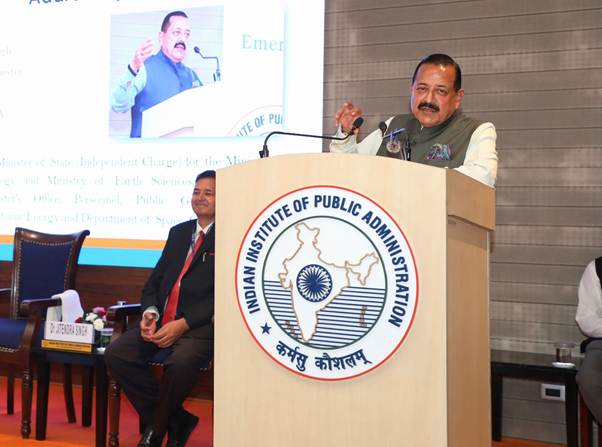
IIPA AGM News – Indian Bureaucracy Network | Union Minister of State (Independent Charge) for Science and Technology; Earth Sciences and Minister of State for the Prime Minister’s Office, Department of Atomic Energy, Department of Space, Personnel, Public Grievances and Pensions, Dr. Jitendra Singh has underlined that the Indian Institute of Public Administration (IIPA) is closely aligning itself with the Modi government’s transformative shift from a rule-bound system to a role-based model of governance. This shift, he emphasized, is central to enhancing administrative responsiveness and is directly contributing to a more efficient and citizen-centric Indian Bureaucracy.
Speaking as Chairman of IIPA during the 71st Annual General Body Meeting, chaired by Vice President of India Shri C.P. Radhakrishnan, who also serves as the President of IIPA, Dr. Jitendra Singh noted that the institute has witnessed a remarkable transformation over the last 11 years. This period, he said, has been marked by structural reforms that have reshaped IIPA into a forward-looking knowledge hub supporting future-ready governance. Such developments are frequently highlighted across platforms covering Indian Bureaucracy Latest News and Top Indian Bureaucracy News, reflecting the institute’s growing national relevance.
One of the most notable changes is the expansion of IIPA’s membership base. Earlier perceived as a forum largely for retired civil servants, the institution has now diversified its membership to include serving officers, elected representatives such as councillors and corporators, professionals from the private sector, and even personnel from the defence forces. Dr. Singh remarked that the youngest members today are in their mid-twenties, demonstrating the institute’s renewed appeal and its evolving role in shaping a dynamic governance ecosystem. This broad-based approach mirrors national administrative trends often seen in Indian Bureaucracy Appointments and Latest Indian Bureaucracy News.

Alongside membership reforms, the physical and functional infrastructure of IIPA has undergone major enhancements. The campus now features newly developed boardrooms of varied capacities, equipped with modern audiovisual and conferencing technologies. These upgrades support high-quality discussions, training sessions, and collaborative activities essential for developing contemporary administrative capabilities. Dr. Singh proudly shared that IIPA has also set up a professional-grade digital studio—one of the first of its kind within a government institution—facilitating digital learning, virtual training, and wider communication outreach.
Aligning itself with national governance priorities, IIPA has strengthened its role in capacity building, administrative reforms, and technology-led learning. The institute has been a key contributor to Mission Karmayogi, the government’s flagship capacity-building mandate, and the iGOT platform, designing online learning modules and training programs for officials at various tiers. This aligns seamlessly with reforms aimed at enhancing transparency, accountability, and service delivery. Dr. Singh highlighted that more than 1,700 obsolete rules and procedures have been abolished in recent years, enabling a more trust-based and efficient administrative framework—an area that regularly features in Indian Bureaucracy Transfers News.
Another important milestone has been IIPA’s expanding collaborations with industry and academia. The Minister noted partnerships with companies like Tata Motors and Maruti, which have helped design innovative training modules that combine best practices from both public and private sectors. These collaborations foster a holistic learning environment and help bridge gaps between traditional government functioning and modern management systems. According to Dr. Singh, such cross-sector partnerships are vital for building a governance model that is outcome-focused and agile.
Complementing its structural and functional evolution, IIPA has also strengthened its scholarly contributions. Recent publications like People-Centric Governance: Indian Perspective and Artificial Intelligence for Social Justice showcase the institute’s commitment to blending classical administrative principles with emerging contemporary challenges such as technological disruption, data-driven governance, and social equity.
In conclusion, Dr. Jitendra Singh reiterated that IIPA is steadily evolving from a traditional training institute into a comprehensive governance resource centre. Its transformation reflects a broader national vision aimed at shaping institutions and professionals who can meet the expectations of next-generation governance—governance that is adaptive, inclusive, innovative, and designed to serve citizens more effectively. As the landscape of governance continues to evolve, institutions like IIPA will play a pivotal role in strengthening public administration and shaping the future of governance discourse in India.