


Summary:Researchers have succeeded in detecting anti-avian influenza virus antibody in blood serum within 20 minutes, using a portable analyzer they have developed to conduct rapid on-site bio tests. If a suitable reagent is developed, this technology could be used to detect antibodies against SARS-CoV-2, the causative virus of COVID-19.
Researchers have succeeded in detecting anti-avian influenza virus antibody in blood serum within 20 minutes, using a portable analyzer they have developed to conduct rapid on-site bio tests. If a suitable reagent is developed, this technology could be used to detect antibodies against SARS-CoV-2, the causative virus of COVID-19.
Avian influenza is a poultry disease caused by influenza A virus infection. Rapid initial response for a suspected infection and continuous surveillance are essential to mitigate the damage from highly pathogenic, transmittable pathogens such as avian influenza viruses.
Generally, the polymerase chain reaction (PCR) method is used to detect the viral genome, but its complicated procedure requires a considerable amount of time. Another method involves detecting antibodies produced in the body in reaction to virus infection. However, widely used antibody detection methods can be inaccurate because the antibodies’ existence is generally determined by eyesight.
The group, including Keine Nishiyama, a doctoral student at Hokkaido University’s Graduate School of Chemical Science and Engineering, and Professor Manabu Tokeshi of the university’s Faculty of Engineering, conducted this study to develop a new method and analyzer capable of rapid, facile and selective detection of antibodies. The method is based on conventional fluorescence polarization immunoassay (FPIA) but applies a different measurement mechanism to make the analyzer much smaller and portable. The analyzer weighs only 5.5 kilograms.
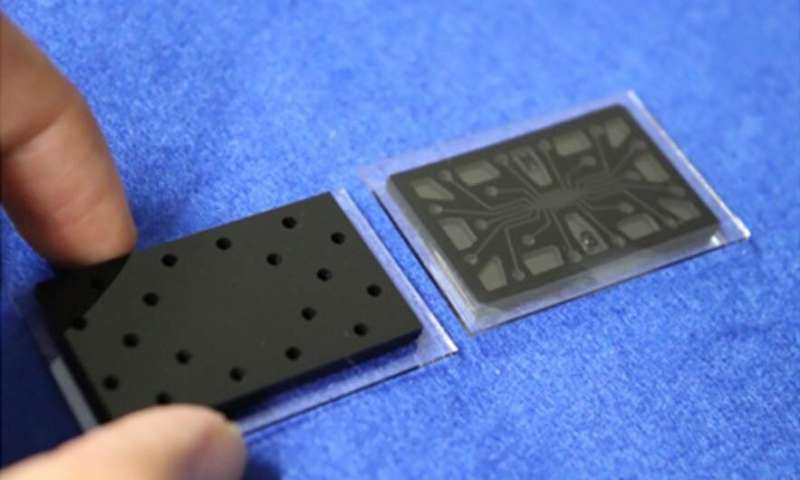
The combined use of liquid crystal molecules, an image sensor and the microfluidic device makes it possible to simultaneously examine multiple samples and reduces the volume of each sample required. Liquid crystal molecules are capable of controlling the polarization direction of fluorescent light, while the microfluidic device has a number of microchannels as a measurement vessel.
The group also developed a reagent to detect anti-H5 avian influenza virus antibody, a fluorescein-labeled protein that binds only with the antibody. The reagent was made by reproducing hemagglutinin (HA) protein fragments, which are expressed on the surface of H5 avian influenza virus, through gene recombination and by labeling fluorescent molecules to the fragments.
To make the measurement, serum collected from birds was mixed with the reagent and left for 15 minutes. The mixture was injected into the microfluidic device and measured with the portable fluorescence polarization analyzer. Molecular movements of the reagent bound with the antibody will be smaller in the liquid, producing a different degree of polarization from the reagent not bound with the antibody. The system can detect anti-H5 avian influenza virus antibody with only 2 microliters of serum sample and within 20 minutes.
“Our analyzer could be used to conduct other bio tests if suitable reagents are developed,” says Tokeshi. The group has already successfully detected mycotoxin and drug constituents. “By reproducing fragments of spike proteins expressed in the novel coronavirus, and using them as the reagent, the analyzer should be able to detect anti-coronavirus antibodies.”
More: Science Daily