


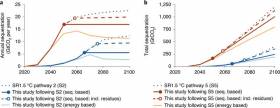
Summary:Bioenergy with Carbon Capture and Storage (BECCS), a negative emission technology, has been considered inevitable to achieve the 2°C or 1.5°C climate goal. Although numerous studies have been conducted, the effect of irrigation remains largely unexplored when taking water use sustainability into consideration. A new study finds that although unlimited irrigation could increase the global BECCS potential by 60-71% by the end of this century, sustainably constrained irrigation would increase it only 5-6%.
A new collaborative research led by researchers from the National Institute for Environmental Studies, Potsdam Institute for Climate Impact Research, Ritsumeikan University, and Kyoto University found that although unlimited irrigation could increase global BECCS potential (via the increase of bioenergy production) by 60-71% by the end of this century, sustainably constrained irrigation would increase it by only 5-6%. The study has been published in Nature Sustainability on July 5.
Bioenergy with carbon capture and storage (BECCS) is a process of extracting bioenergy from biomass, then capturing and storing the carbon to a geological reservoir. It is a negative emission technology since the biomass is produced by plants through photosynthesis that can uptake the carbon dioxide from atmosphere. To achieve the 2°C or 1.5°C climate goal, large-scale deployment of BECCS was assumed to be prominent in many previous studies. However, this caused increasing concerns on the challenges brought to water and land resources to grow the bioenergy crops. For example, existing studies have showed that irrigation to achieve considerable bioenergy crop production needed for BECCS potential comparable to the requirement of 2°C or 1.5°C climate goal would lead to severe water stress even than climate change itself.
Under this context, where and to what extent irrigation can enhance the global BECCS potential remains unknown under sustainable water use. “Here, we define it as water use securing the local and downstream water availability for conventional water use and environmental flow requirements, suppressing nonrenewable water resources withdrawal, and preventing additional water stress.” explains lead author Zhipin Ai from National institute for environmental studies, Japan.
The study was based on simulations with a spatially explicit representation of bioenergy crop plantations and water cycle in an internally consistent model framework. To quantitatively determine the constraints of irrigation water resources, the researchers designed distinct irrigation ways (unlimited irrigation, sustainable irrigation, and no irrigation) with bioenergy crops planted on land scenarios with strict land protections to prevent adverse effects on biodiversity, food production, land degradation, and desertification due to large-scale land conversion.
The study found that, under the rain fed condition, the average global BECCS potential in 2090 was 0.82-1.99 Gt C yr-1. The BECCS potential reached 1.32-3.42 Gt C yr-1 (60% and 71% increases compared to that under rainfed condition) under full irrigation, whereas under sustainable irrigation, the BECCS potential was 0.88-2.09 Gt C yr-1 (5% and 6% increases compared to that under rainfed condition). The BECCS potential under sustainable irrigation is close to the lower limit of 1.6-4.1 Gt C yr-1, which is the required amount of BECCS in 2100 that consistent with the 1.5°C or 2°C climate goal as documented in the IPCC Special Report on Global Warming of 1.5ºC.
Given the many negative environmental impacts of large-scale deployment of BECCS, the researchers suggest that comprehensive assessments of the BECCS potential that consider both potential benefits and adverse effects are necessary for simultaneously achieving the multiple sustainable development goals on climate, water, land, etc. “In addition, considering the relatively low biophysically constrained BECCS potential under sustainable water and land use scenarios, a critical reexamination of the contribution of BECCS towards achieving the Paris Agreement goal is needed.” says co-author Vera Heck from the Potsdam Institute for Climate Impact Research.
This study was supported by the Environment Research and Technology Development Fund (JPMEERF20202005, JPMEERF15S11418, and JPMEERF20211001) of the Environmental Restoration and Conservation Agency of Japan.