


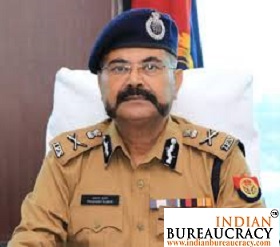
Indian Bureaucracy News, Lucknow, December 18, 2025| The Uttar Pradesh government on Wednesday appointed former Director General of Police Shri Prashant Kumar IPS (Retd.) as the Chairman, Uttar Pradesh Education Service Selection Commission (UPESSC), a statutory body created to overhaul teacher recruitment in the State after years marked by large-scale irregularities, prolonged litigation and repeated administrative setbacks.
Why Yogi Govt. chose Ex-DGP to Oversee Teacher Recruitment
The Yogi government’s decision to appoint former Director General of Police Prashant Kumar (dt 17.12.2025) as Chairperson of the Uttar Pradesh Education Service Selection Commission (UPESSC) reflects the government’s acknowledgement that the crisis confronting public recruitment in Uttar Pradesh is no longer merely administrative, but structural, and that there is an urgent need to restore credibility to a system long mired in corruption and struggling to inspire confidence, particularly among the youth.
Over the past decade, teacher recruitment in Uttar Pradesh has repeatedly faltered under the weight of court disputes, procedural lapses and allegations of organised fraud, leaving lakhs of aspirants uncertain about both timelines and outcomes. The consequences have been structural. According to UDISE+ estimates (September 2025), the State faces nearly 1.94 lakh teacher vacancies across educational levels—the highest in the country—even as the government plans phased recruitment of around two lakh posts by March 2026 to address the deficit.
It was against this backdrop that the Uttar Pradesh Education Service Selection Commission was established under the UPESSC Act, 2023, as a unified institutional framework to replace multiple recruitment bodies operating in silos. The dissolution of the Higher Education Service Commission and the Secondary Education Service Selection Board, and their merger into the UPESSC, was presented as a structural reset aimed at reducing overlap, standardising procedures and minimising legal vulnerabilities across basic, secondary and higher education.
However, the commission’s creation itself was shaped by crisis. Years of reservation-related litigation, cancelled examinations and contested merit lists had repeatedly stalled recruitment cycles across sectors. Large-scale selections were often delayed or stayed midway, compounding uncertainty for candidates and weakening confidence in the State’s recruitment machinery. As a result, the UPESSC inherits not only a wide mandate but also a deeply compromised institutional legacy.
More significantly, the challenge before the new commission goes beyond administrative reform. Over the past five years, multiple cases have reinforced long-standing concerns about the involvement of organised recruitment rackets at the institutional level, rather than loosely coordinated groups of individuals. These rackets often involve forged degrees, identity theft, and manipulated verification processes, frequently indicating collusion between intermediaries and officials. Such episodes highlight that the problem is not merely procedural but one of governance and enforcement.
Shri Prashant Kumar’s appointment comes at a time when public recruitment is under scrutiny and youth unemployment remains high. A 1990-batch IPS officer who retired as DGP on May 31, 2025, he brings with him an operational understanding of how organised fraud networks function—and how they may be disrupted within institutional systems. With a tough record on organised crime, anti-mafia campaigns, and the UP Special Security Force, Shri Kumar is an experienced officer the government aims to leverage in a sector vulnerable to recruitment mafias.
Teacher recruitment in Uttar Pradesh between 2020 and 2025 has been plagued by large-scale, highly organised fraud and scam operations involving identity theft, forged degrees, quota anomalies, and collusion between intermediaries and officials. The 69,000 Assistant Teachers Recruitment Scam exposed reservation irregularities affecting over 15,000 seats, arrests of individuals such as former Zila Panchayat members, and recovery of cash and luxury vehicles linked to the racket. Investigations into fake credentials led to mass dismissals of over 2,460 teachers and schemes such as the Anamika Shukla case, where salaries were fraudulently drawn in her name across 25 different schools, continuing even after the initial exposure in 2020.
Recent cases in Mau and Ballia highlight the scale and sophistication of recruitment mafias in Uttar Pradesh. In Mau district, an FIR was registered earlier this year against 72 individuals for fraudulent appointments in aided Ambedkar schools. Those implicated include 42 assistant teachers who allegedly used forged academic certificates, three former district social welfare officers, multiple education department officials responsible for verification, and managers of 19 government-aided schools. The complaint revealed that appointments dating back to 2014 were based on fabricated documents, exposing prolonged institutional failure rather than isolated misconduct. In Ballia, intermediaries defrauded aspirants of nearly ₹1 crore through fake appointment letters, demonstrating how desperation and systemic opacity are exploited for financial gain. While the amounts differ across cases, the underlying pattern—the monetisation of access to public employment—remains consistent.
The Uncomfortable Question
In almost all the cases, the fraud was organised and collaborative. Particularly significant is the inclusion of verifying authorities among the accused, shifting the focus from beneficiaries alone to those entrusted with gatekeeping responsibilities. From a governance perspective, this raises uncomfortable questions about oversight, due diligence and accountability in recruitment systems that combine public funding with private management.
These cases have broader implications for the UPESSC. Beyond conducting examinations and issuing select lists, the commission is now expected to act as a firewall against systemic manipulation. This will require not just procedural cleanliness but integration with robust verification mechanisms, coordination with enforcement agencies and adoption of technology-driven checks, including digital authentication of academic credentials. The expectation is that leadership with experience in dismantling organised networks may be better placed to anticipate and neutralise attempts to subvert the process.
At the same time, the appointment also raises questions about institutional balance. Education recruitment bodies are traditionally staffed by academicians and administrators with subject-matter expertise. A former police chief at the helm represents a departure from convention, reflecting the State’s assessment that the immediate crisis is one of integrity rather than pedagogy. Whether this approach can deliver long-term institutional reform without over-securitising a civilian process will be closely watched.
For aspirants, the stakes are high. Teacher recruitment in Uttar Pradesh affects lakhs of candidates and underpins the functioning of schools, colleges and vocational institutions across the State. Repeated cancellations and scandals have not only delayed careers but also weakened trust in public employment systems. Any credible turnaround will need consistency over multiple recruitment cycles, not merely firm messaging or isolated crackdowns.
Shri Kumar’s challenge, therefore, extends beyond enforcing discipline. It lies in embedding transparency into routine processes so that integrity does not depend on individual vigilance alone. If the UPESSC can combine administrative clarity with credible deterrence against fraud, it may begin to reverse the erosion of trust that has characterised teacher recruitment in recent years. Whether a policing mindset can be translated into durable institutional reform is a question that the commission’s functioning over the next few years will answer.
IndianBureaucracy.com wishes Shri Prashant Kumar the very best.