


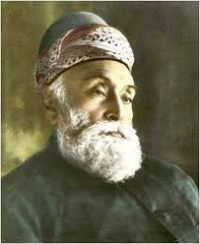
Tata Founders Day 03.03.2026 | Those who create history, without seeking or holding power, are truly great – PM Modi talks about JN Tata.
“That he was a man of destiny is clear. It would seem, indeed, as if the hour of his birth, his life, his talents, his actions, the chain of events which he set in motion or influenced, and the services he rendered to his country and to his people, were all pre-destined as part of the greater destiny of India.” — J. R. D. Tata
https://www.tata.com/about-us/tata-group-our-heritage/tata-titans/jamsetji-tata
“Be sure to lay wide streets planted with shady trees, every other of a quick-growing variety. Be sure that there is plenty of space for lawns and gardens. Reserve large areas for football, hockey and parks. Earmark areas for Hindu temples, Mohammedan mosques and Christian churches.” —Tata in a letter to son Dorab about his vision for the township that would eventually become Jamshedpur.
Jamsetji Nusserwanji Tata – The Visionary Founder of the Tata Group
Jamsetji Nusserwanji Tata, popularly known as J. N. Tata, was one of India’s greatest industrial pioneers and the visionary founder of the Tata Group. Born on March 3, 1839, in Navsari, Gujarat, he laid the foundation of what would become India’s largest and most respected business conglomerate. At a time when India was under British colonial rule and industrial development was limited, Tata dreamed of building institutions that would promote economic self-reliance, scientific research, and industrial growth.
Early Life and Education
Jamsetji Tata was born into a Parsi family. His father, Nusserwanji Tata, was among the first in the family to venture into business. Jamsetji graduated from Elphinstone College in Bombay (now Mumbai) in 1858. Soon after, he joined his father’s trading firm and gained valuable experience in commerce, cotton trading, and international business practices. His travels to countries such as England, China, and Japan exposed him to modern industrial methods and strengthened his resolve to bring similar progress to India.
Beginning of an Industrial Journey
The American Civil War (1861–1865) temporarily boosted India’s cotton exports, and Tata utilized this opportunity to learn the dynamics of global trade. However, unlike many traders of the time, he was not content with being a middleman. He believed India must move from trading raw materials to manufacturing finished goods.
In 1868, with a capital of Rs. 21,000, he founded a private trading firm that marked the beginning of the Tata Group. In 1877, he established the Empress Mills in Nagpur, choosing the location strategically for its proximity to cotton-growing regions and railway lines. His textile mills were known not only for quality production but also for progressive labour practices. He introduced welfare measures such as pensions for workers, accident compensation schemes, and proper ventilation—revolutionary steps for that era.
Vision for Steel and Industrial Power
Jamsetji Tata believed that steel production was critical to nation-building. He famously declared that if India produced steel, the British would buy it. Though he did not live to see the realization of this dream, his efforts led to the establishment of Tata Iron and Steel Company (now Tata Steel) in 1907 by his sons. The steel plant at Jamshedpur became a symbol of India’s industrial capability.
His vision extended beyond steel. He also conceived the idea of generating hydroelectric power to provide affordable energy to industries. This idea eventually led to the formation of Tata Power. Tata understood that industrial progress required reliable infrastructure, and he aimed to create it indigenously.
Commitment to Education and Research
Perhaps one of Jamsetji Tata’s most enduring contributions was his commitment to higher education and scientific research. He strongly believed that national progress depended on scientific advancement. He envisioned a world-class research institution in India that would promote innovation and knowledge creation.
This dream materialized as the Indian Institute of Science (IISc) in Bangalore, which was established in 1909 with support from the Government of India and the Maharaja of Mysore. Today, IISc stands as one of India’s premier research institutions, reflecting Tata’s foresight in promoting science and technology.
In addition to IISc, the Tata family later established institutions such as the Tata Institute of Social Sciences (TISS) and the Tata Memorial Hospital, continuing his legacy of philanthropy and nation-building.
Hospitality with a National Spirit
Jamsetji Tata also entered the hospitality industry with a strong sense of national pride. Disturbed by racial discrimination faced by Indians in British-run hotels, he decided to build a grand hotel that would be open to all. The result was The Taj Mahal Palace Hotel in Mumbai, which opened in 1903. It became one of India’s most iconic landmarks and symbolized Indian excellence in hospitality.
Ethical Business Practices
Long before corporate social responsibility became a global concept, Jamsetji Tata practiced it as a core business philosophy. He believed that business existed not merely for profit but for the larger good of society. His approach combined commercial success with social welfare.
He once said that the community is not just another stakeholder but the very purpose of business. This principle remains deeply embedded in the Tata Group’s governance structure, where a significant portion of profits is channeled into charitable trusts that fund education, healthcare, and rural development.
Leadership Style and Values
Jamsetji Tata was known for his humility, integrity, and long-term vision. He was not merely an industrialist but a nation-builder who thought decades ahead of his time. His leadership style emphasized innovation, employee welfare, and institutional development rather than short-term gains.
He believed in empowering capable individuals and giving them freedom to execute ideas. His sons, Sir Dorabji Tata and Sir Ratan Tata, carried forward his vision after his death in 1904, expanding the group into steel, power, chemicals, automobiles, and more.
Legacy and Impact
Today, the Tata Group operates in over 100 countries across six continents, with interests in steel, automobiles, information technology, telecommunications, hospitality, and consumer goods. Companies like Tata Steel, Tata Motors, Tata Consultancy Services (TCS), and Tata Power trace their roots back to Jamsetji Tata’s foundational vision.
Beyond business success, his true legacy lies in institution-building and philanthropy. He demonstrated that industrial growth and social responsibility can go hand in hand. At a time when India lacked political independence, he worked towards economic empowerment, believing that industrial strength was essential for national freedom.
Jamsetji Tata passed away on May 19, 1904, in Bad Nauheim, Germany. However, his ideas and values continue to shape Indian industry more than a century later. He is often regarded as the “Father of Indian Industry,” a title that reflects both his pioneering achievements and his enduring influence.
Jamsetji Nusserwanji Tata was far more than the founder of a business empire. He was a visionary who combined entrepreneurship with patriotism, philanthropy, and ethical governance. His dreams of steel plants, research institutes, power generation, and world-class infrastructure laid the groundwork for modern India’s industrial landscape.
In an era marked by colonial constraints and limited resources, J. N. Tata imagined an India that could compete with the world through innovation, integrity, and enterprise. The institutions he built and the values he established continue to inspire generations of entrepreneurs and leaders. His life stands as a testament to the transformative power of vision, courage, and commitment to nation-building.
This 3rd March , IndianBureaucracy.com forwards its heartiest tribute to J N Tata and his vision.