


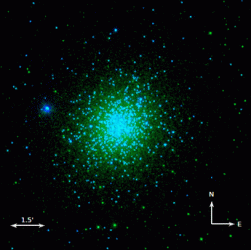
PIB News Update: Astronomers exploring the massive intriguing globular cluster in our Galaxy called NGC 2808 that is said to have at least five generations of stars have spotted rare hot UV-bright stars in it. These stars whose inner core is almost exposed, making them very hot, exist in the late stages of evolution of a Sun-like star. It is not clear how these stars end their lives as not many of them are detected in these fast-evolving phases, making their study crucial.
Motivated by the fact that old globular clusters referred to as dinosaurs of the universe present excellent laboratories where astronomers can understand how stars evolve through various phases between their birth and death, scientists at the Indian Institute of Astrophysics (IIA) an autonomous institute of the Department of Science & Technology, Government of India, looked out for NGC 2808.
With spectacular ultraviolet images of the cluster from Ultraviolet Imaging Telescope (UVIT) onboard India’s first multi-wavelength space satellite, AstroSat, they distinguished the hot UV-bright stars from the relatively cooler red giant and main-sequence stars which appear dim in these images. The findings of this study have been accepted for publication in the journal ‘The Astrophysical Journal’.
The team of scientists comprising Deepthi S. Prabhu, Annapurni Subramaniam and Snehalata Sahu from IIA combined the UVIT data with observations made using other space missions such as the Hubble Space Telescope and the Gaia telescope along with ground-based optical observations. About 34 UV-bright stars were found to be members of the globular cluster. From the data, the team derived the properties of these stars such as their surface temperatures, luminosities and radii.
One of the UV-bright stars was found to be about 3000 times brighter than the Sun with a surface temperature of about 100,000 K. The properties of these stars were then used to place them on what astronomers call the Hertzsprung-Russel (HR) diagram along with theoretical models to throw light on the characteristics of their parent stars and to predict their future evolution. Most of the stars were found to have evolved from a solar stage called the horizontal branch stars with hardly any outer envelope. Thus they were bound to skip the last major phase of life called the asymptotic giant phase and directly become dead remnants or white dwarfs.
Such UV-bright stars are speculated to be the reason for the ultraviolet radiation coming from old stellar systems such as elliptical galaxies which are devoid of young blue stars. Hence, it is all the more important to observe more such stars to understand their properties.
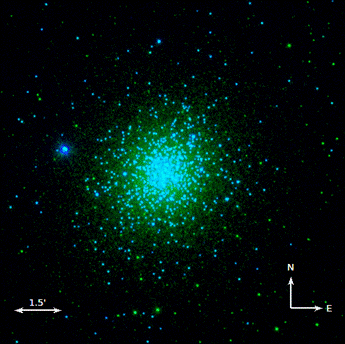
Figure 1: A false colour image of the globular cluster NGC 2808 obtained using AstroSat/UVIT. The stars as seen using far-UV (FUV) filter are shown in blue colour, and the yellow colour is used to show the stars observed in near-UV (NUV).
[Publication link:
arXiv link – https://arxiv.org/pdf/2012.05732.pdf
For further details, Deepthi S. Prabhu ([email protected]) can be contacted.]