


Summary:Shake, rattle and roll. Even though they are miles from the epicenter of an earthquake, buildings can collapse due to how an earthquake energy makes the ground shake and rattle. Now, a team of engineers has designed a flexible material that can help buildings withstand multiple waves of energy traveling through a solid material, including the simultaneous forward and backward and side-to-side motions found in earthquakes.
Shake, rattle and roll.
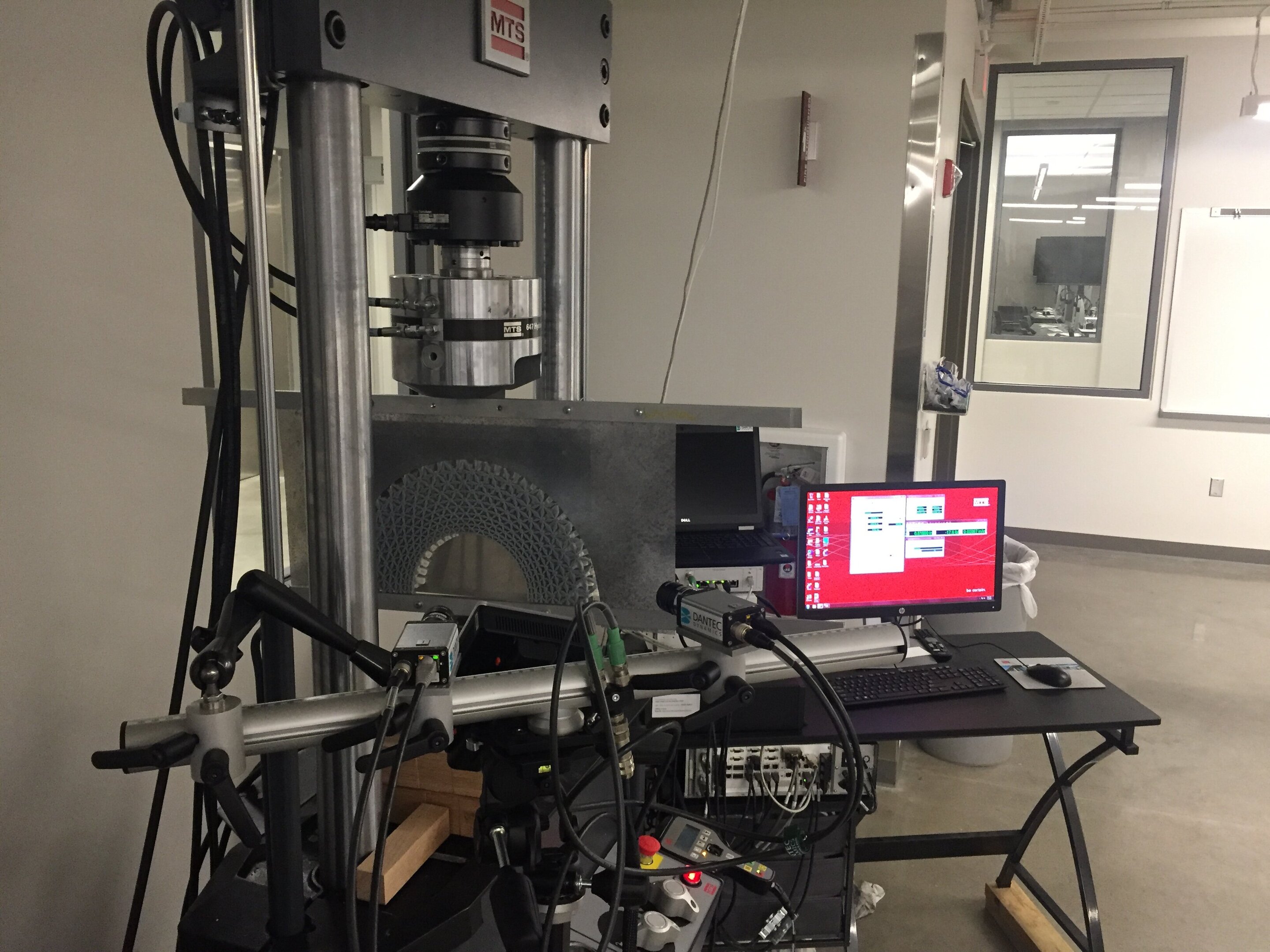
Even though they are miles from the epicenter of an earthquake, buildings can collapse due to how an earthquake energy makes the ground shake and rattle. Now, a team of engineers led by Guoliang Huang, a James C. Dowell Professor in the Mechanical and Aerospace Engineering Department at the University of Missouri College of Engineering, has designed a flexible material that can help buildings withstand multiple waves of energy traveling through a solid material, including the simultaneous forward and backward and side-to-side motions found in earthquakes.
“Our elastic material can stretch and form to a particular surface, similarly to a wrap on a vehicle,” Huang said. “It can be applied to the surface of an existing building to allow it to flex in an earthquake. What is unique about the structured lattice-type material is that it protects against both types of energy waves — longitudinal and sheer — that can travel through the ground.”
Huang said the material also can be used by the defense industry to protect against vibration in mechanical parts, such as aircraft or submarine engines.
“For over 20 years, no one had a natural solution for this issue in a solid material,” Huang said. “Now, we’ve designed, modeled and fabricated a new material with properties that do not exist naturally for what we believe is a nearly perfect protective device.”
The Army Research Office, which provided funding for the basic research effort at the University of Missouri associated with this project, is encouraged by the results from Huang’s team.
“The results that the University of Missouri team has recently published are encouraging,” said Dan Cole, the program manager at the Army Research Office, a part of the U.S. Army Combat Capabilities Development Command’s Army Research Laboratory. “This research could lead to new strategies for steering mechanical waves away from critical regions in solid objects, which could enable novel capabilities in soldier protection and maneuvering.”
The studies, “Polar Metamaterials: A New Outlook on Resonance for Cloaking Applications” and “Physical Realization of Elastic Cloaking with a Polar Material,” were published in Physical Review Letters, a journal of the American Physical Society.
Other authors on the studies include Nassar Hussein, Yangyang Chen, Xianchen Xu and Chen Wangat MU; Wan Shou, Beichen Li and Wojciech Matusik at the Massachusetts Institute of Technology; and Zongliang Du at MU and the Dalian University of Technology in China. The content is solely the responsibility of the authors and does not necessarily represent the official views of the funding agencies.
More: Science Daily