


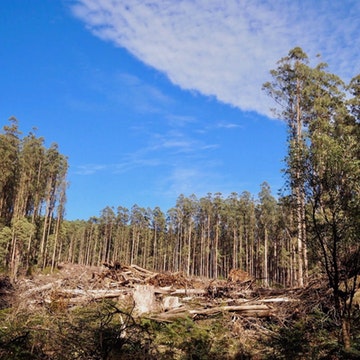
Summary:Continually logging and re-growing tropical forests to supply timber is reducing the levels of vital nutrients in the soil, which may limit future forest growth and recovery, a new study suggests. This raises concerns about the long-term sustainability of logging in the tropics.
Continually logging and re-growing tropical forests to supply timber is reducing the levels of vital nutrients in the soil, which may limit future forest growth and recovery, a new study suggests. This raises concerns about the long-term sustainability of logging in the tropics.
Trees of recovering tropical forests were found to have tougher leaves, with lower concentrations of the nutrients phosphorus and nitrogen — both essential for plant and tree growth — than trees of old-growth forests. This suggests that multiple cycles of logging and recovery irreversibly remove phosphorus from the forest system, and are pushing the nutrient content towards ecological limits.
“Old-growth tropical forests that have been the same for millions of years are now changing irreversibly due to repeated logging,” said Dr Tom Swinfield, a plant scientist in the University of Cambridge Conservation Research Institute, and first author of the paper published in the journal Global Change Biology.
Soil nutrients including phosphorus come from rocks, and are taken up by trees through their roots. Cutting down the trees causes these nutrients to be lost through soil erosion, gas emissions, and removal of nutrients in the extracted timber. The researchers estimate that as much as 30% of the available phosphorus in the soil is being removed from tropical forest systems by repeated logging.
“We see that as the logged forests start recovering, they’re actually diverging from the old growth forests in terms of their leaf chemistry and possibly also species composition, as the amount of available nutrients goes down,” said Swinfield. “At the moment the trees can cope, but the fact that they’re changing indicates phosphorus levels in the soil are dropping. This could affect the speed at which forests recover from future disturbances.”
The researchers created high definition images of a forest landscape in north-eastern Borneo using LIDAR-guided imaging spectroscopy from an aircraft. This is a method of remote sensing, using a laser scanner and high fidelity camera, which takes hundreds of measurements across the light spectrum. They combined this information with nutrient measurements from 700 individual trees in the forest. This allowed them to map the concentrations of nutrients in the trees’ leaves over an area containing repeatedly logged forest and old-growth forest, and compare the two.
This is the first landscape-scale study of how leaf function changes in response to logging. Selective logging is carried out extensively across millions of hectares of forest in the tropics, so that degraded forests are now more widespread than old-growth forests. The study suggests that each consecutive harvest reduces the level of nutrients in the system, and newly established trees have to adapt to conserve the scarce resources available to them.
“Phosphorus limitation is a really serious global issue: it’s one of the areas where humans are using a vital resource beyond sustainable levels,” said Professor David Coomes, Director of the University of Cambridge Conservation Research Institute, who led the project. The researchers found that differences from old-growth forest become more pronounced as logged forests grow larger over time, suggesting exacerbated phosphorus limitation as forests recover.
More: Science Daily