



A team of scientists, including Indian and International collaborators, have derived the accurate value of Pluto’s atmospheric pressure at its surface. It is more than 80,000 times less than the atmospheric pressure at mean sea level on Earth.
The pressure was calculated from data obtained by observation of stellar occultation by Pluto on 6 June 2020 using 3.6-m Devasthal optical telescope (DOT) (India’s largest optical telescope) and 1.3-m Devasthal Fast Optical Telescope (DFOT) telescopes located at Devasthal, Nainital.
In astronomy, an occultation happens when a celestial object gets hidden from the view of the observer due to another celestial object passing in between them. A compilation of twelve stellar occultations by Pluto observed between 1988 and 2016 showed a three-fold monotonic increase of atmospheric pressure during this period.
An international team of scientists, including members from Aryabhatta Research Institute of Observational Sciences (ARIES), used signal-to-noise ratio light curves obtained from the sophisticated instruments used in the observations to derive an accurate value of Pluto’s atmospheric pressure at its surface. It was found to be 12.23 μbar — 80,000 times less than the atmospheric pressure at mean sea level on Earth. They also found that the pressure at the surface is close to the seasonal peak of Pluto.
The research published in ‘Astrophysical Journal Letters (ApJL)’ showed that since mid-2015, Pluto’s atmosphere is in a plateau phase close to peak and is in excellent agreement with the model values calculated earlier by the Pluto volatile transport model in 2019. The team explained further that this occultation was particularly timely as it can test the validity of the current models of Pluto’s atmosphere evolution.
The study also confirms earlier findings that Pluto suffers intense seasonal episodes because of large depression on Pluto, known as Sputnik Planitia. Pluto’s poles remain, for decades, in permanent sunlight or darkness over its 248-year long orbital period leading to strong effects on its Nitrogen (N2) atmosphere that is mainly controlled by vapour pressure equilibrium with the surface N2 ice. Moreover, as Pluto is now moving away from the Galactic plane as seen from Earth, stellar occultations by the dwarf planet are becoming increasingly rare, making this event a decisive one.
Publication link: https://iopscience.iop.org/article/10.3847/2041-8213/ac4249
Contributors: Bruno Sicardy, Nagarhalli M. Ashok, Anandmayee Tej, Ganesh Pawar, Shishir Deshmukh, Ameya Deshpande, Saurabh Sharma, Josselin Desmars, Marcelo Assafin, Jose Luis Ortiz, Gustavo Benedetti-Rossi, Felipe Braga-Ribas, Roberto Vieira-Martins, Pablo Santos-Sanz, Krishan Chand, and Bhuwan C. Bhatt
For more details, Dr. Saurabh (ARIES) (saurabh[at]aries.res.in), Prof. N M Ashok (PRL) (ashoknagarhalli[at]gmail.com), Prof. Anandmayee Tej (IIST) (tej[at]iist.ac.in) can be contacted.
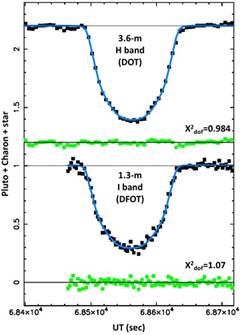
Figure: The blue curves are a simultaneous fit to the 6 June 2020 stellar occultation by Pluto light curves (black squares) obtained with the 3.6-m and 1.3-m telescopes of ARIES at Desvasthal, over a 320-s interval bracketing the event. The residuals (observation-minus-model) are plotted in green below each light curve. The value of χ2d of, the χ2 per degree of freedom for each fit, is displayed at the lower right corner of each light curve. The lower and upper horizontal lines are the normalized total flux (star+Pluto+Charon) and the zero flux levels, respectively. The 3.6-m light curve has been shifted vertically by +1.2 for better viewing.


a) 1.3m DFOT b) 3.6 m DOT