


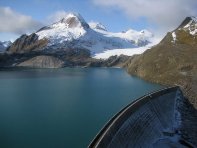
Summary:Water management in reservoirs could substantially mitigate future summer water shortages, expected as a consequence of ongoing glacier retreat, researchers report. The team simulated the effect of climatic change on glaciers across the European Alps and estimated that two thirds of the effect on seasonal water availability could be avoided when storing water in areas becoming ice free.
Water management in reservoirs could substantially mitigate future summer water shortages, expected as a consequence of ongoing glacier retreat. This is the result of a study published in Environmental Research Letters and led by the Swiss Federal Research Institute WSL. The team simulated the effect of climatic change on glaciers across the European Alps and estimated that two thirds of the effect on seasonal water availability could be avoided when storing water in areas becoming ice free.
Environments with snow and glaciers play a vital role in terms of water availability. With warmer temperatures, snow covered areas will reduced in size and duration, whilst glaciers are expected to retreat substantially. This is anticipated to significantly affect the seasonality of runoff, and to result in a reduction of the water yields from high-mountain areas.
A new study jointly led by the Swiss Federal Institute for Forest, Snow and Landscape Research (WSL), the Joint Research Centre of the European Commission in Ispra, Italy, and the Laboratory of Hydraulics, Hydrology and Glaciology (VAW) at ETH Zurich, presents for the first time an estimate for the potential of mitigation by managing water through reservoirs. The basic idea is to transfer the additional water expected to be available during spring because of an earlier onset of the melting season, to the summer months. This could compensate for the reduction in water yields expected as a result of glacier shrinkage.
By using the latest climate projections and a numerical glacier model developed recently, the authors estimate that for the European Alps, up to two thirds of the expected changes could potentially be mitigated by the end of the century. This would require a temporary storage of about 1 km3 of water — that is a water cube with edges 1 km long.
Artificial dams
Somewhat provocatively, the authors compare this storage need with the potential volume that would be available if artificial dams would be installed in the locations of the retreating glaciers. For doing so, the authors virtually placed dams at current glacier positions and computed the volume of each lake being formed. The results show that the potentially available volume is ten times larger than the required one, and that about a dozen of centralized dams would be sufficient for meeting the storage demand.
The study, however, also highlights how such a technical solutions would only solve part of the problem: On the one hand, there is the difficulty of centralizing the water of the many glaciers (about 4000 today) across the Alps; on the other, the hypothetical seasonal water transfer would not be able to compensate the overall water loss caused by glacier retreat. The authors estimate that by 2100, the runoff from glaciers in the European Alps will be reduced by an amount corresponding to about 80% of Switzerland’s freshwater consumption today.
Source:Swiss Federal Institute for Forest, Snow and Landscape Research WSL(sience)