


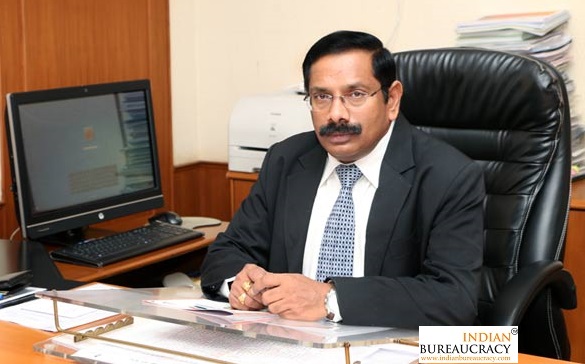
Indian Bureaucracy News, Amaravati, December 06, 2025 | The Andhra Pradesh government has extended the tenure of the present Chief Secretary K Vijayanand IAS (Andhra Pradesh 1992), who has held the position since December 30, 2024, for three more months from December 1, 2025, to February 28, 2026. Vijayanand was due to retire on November 30, 2025. In the same order, the government named senior bureaucrat Shri G Sai Prasad IAS (Andhra Pradesh 1991) as his successor with effect from March 1, 2026. His scheduled retirement is on 31 December 2026, giving him a nearly ten-month window to serve as Chief Secretary unless the government opts for an extension. The DoPT granted the extension at the behest of the State government, which wanted Shri Vijayanand to stay on through the financial year’s most sensitive quarter.
The decision reflects more than a routine administrative preference for continuity. December to March is the period when the State Budget, fiscal planning, audit preparations and annual reviews converge, making it the least ideal moment for an abrupt change at the top of the bureaucracy. With the government navigating a demanding governance cycle and sensitive political transitions, the Naidu administration has opted for predictability over disruption.
For the state of Andhra Pradesh, multiple high-stakes processes that demand administrative continuity are underway. Andhra Pradesh is currently negotiating renewable-energy MoUs, interstate power-sharing arrangements, and central funding under flagship schemes such as the Jal Jeevan Mission and PM Gati Shakti. Parallel discussions on special assistance and the restructuring of State debt are also in advanced stages. These are relationship-driven negotiations that rely heavily on institutional memory — a factor the government was unwilling to disrupt at this juncture.
Several of the government’s flagship reform initiatives — including water-resource optimisation, land administration restructuring, and district-level governance reforms — are also at transition points. With review cycles, implementation milestones and evaluation reports scheduled through February, officials familiar with the internal processes argue that retaining the Chief Secretary for the quarter reduces friction and ensures continuity in decision-making. Vijayanand is also seen as a key link between the State and the Centre at a time when smooth coordination is essential for securing clearances and financial flows tied to infrastructure and energy-sector projects.
The extension also shapes a more deliberate succession. Shri G Sai Prasad, a 1991-batch IAS officer currently serving as Special Chief Secretary (Water Resources) and Ex-Officio Special Chief Secretary to the Chief Minister, has been designated to take over from March 1, aligning the transition with the post-Budget administrative cycle. This allows the incoming Chief Secretary to assume charge at a natural break point rather than mid-preparation, creating space for a more structured handover.

Shri Sai Prasad, born on May 6, 1966, joined the IAS at the age of 25 after clearing the Civil Services Examination in 1990. An engineer with an M.Tech. degree, he has built his career across key sectors including energy, infrastructure, housing, land administration and power utilities. His assignments have ranged from Project Officer at ITDA Paderu and Commissioner of the Guntur Municipal Corporation to Collector of Chittoor, Joint Secretary in the Ministry of Power, and Chairman and Managing Director in multiple state power corporations. More recently, he has served as Principal Secretary and subsequently Special Chief Secretary in the Chief Minister’s Office and the Water Resources Department. He is due to retire in December 2026.
Within the government, Sai Prasad is regarded as a calm, methodical administrator who has handled politically sensitive portfolios without theatrics. His long association with water management and his record in steering energy-sector reforms make him a natural fit for the top administrative position at a time when the state is focused on irrigation modernisation, reviving power-sector finances and completing a series of large-scale infrastructure commitments.
The timing of the transition points to a clear administrative priority; avoiding disruption during a period packed with fiscal reviews, project clearances and Centre–State coordination. Retaining Shri Vijayanand through the final quarter of the financial year, while preparing Shri Sai Prasad to take charge from March 1, allows the government to move into the Budget cycle without an abrupt change at the top. Whether this continuity ultimately shapes outcomes will become evident only in the coming months, but for now the State has opted for predictability over experimentation.
IndianBureacracy.com wishes both the officers the very best.