


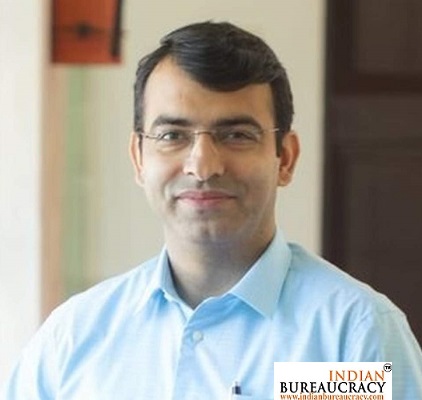
Amit Satija IAS appointed as Joint Secretary- Eighth Central Pay Commission
Shri Amit Satija IAS (AGMUT 2008) presently Joint Secretary- Department of Defence Production has been appointed as Joint Secretary- Eighth Central Pay Commission (8th CPC) under the Department of Expenditure for an overall tenure of five years upto
16.04.2028 by the Appointments Committee of the Cabinet.
Shri Amit Satija, a distinguished officer of the Indian Administrative Service, has built a notable career marked by diverse administrative experience and strong expertise in finance, defence, and governance. Currently serving as Joint Secretary (Joint Secretary Equivalent) in the Department of Expenditure, Ministry of Finance, Government of India, he is associated with matters related to the Pay Commission, a critical area influencing compensation structures of central government employees. His appointment to this important position reflects his deep understanding of financial administration and policy formulation, placing him at the centre of a key institutional process closely followed in Indian Bureaucracy Latest News.
Academically accomplished, Shri Satija holds a B.A. (Honours) in Economics from Patna College, Patna University, where he graduated with First Division. He further enhanced his academic credentials by pursuing a Master of Management Studies (M.M.S.) from Jamnalal Bajaj Institute of Management Studies, Mumbai University, also securing First Division. This strong academic grounding in economics and management has significantly contributed to his analytical approach and decision-making abilities in public administration.
In his current role since April 2026, Shri Satija is involved in financial policy matters related to expenditure management and pay structure reforms, which have wide-ranging implications for government functioning and fiscal planning. Prior to this, he served as Joint Secretary in the Department of Defence Production under the Ministry of Defence from August 2024 to April 2026. In this capacity, he played an important role in overseeing aspects of defence manufacturing, policy coordination, and strategic initiatives aimed at strengthening India’s indigenous defence production ecosystem.
His earlier tenure in the same department as Director further strengthened his expertise in defence administration and public policy. Shri Satija has also held the position of Director (Census Operations) in the Andaman and Nicobar Islands, contributing to the management of critical data systems that support governance and planning.
Shri Satija’s experience extends to key administrative roles in Union Territories and state governments. He served as Secretary in the Union Territory of Lakshadweep, where he handled financial administration and governance matters. His tenure in Goa included roles such as Secretary in the Housing and Urban Development Department and Commissioner of Excise, where he was responsible for revenue administration and regulatory functions.
In the Government of the National Capital Territory of Delhi, he held important field and departmental positions, including District Magistrate of West Delhi, Deputy Commissioner (Revenue) in North Delhi, and Director (Finance) in the Delhi Jal Board. These assignments provided him with valuable grassroots experience in district administration, urban governance, and financial management. He also served as Additional Commissioner in the Transport Department, handling administrative and regulatory responsibilities.
Earlier in his career, Shri Satija served in the Andaman and Nicobar Islands in roles such as Secretary and Director (Tourism) and Assistant Commissioner, gaining exposure to developmental administration in geographically unique and strategically significant regions. His foundational training at the Lal Bahadur Shastri National Academy of Administration (LBSNAA), Mussoorie, laid the groundwork for his professional journey.
Throughout his career, Shri Amit Satija has demonstrated a consistent ability to handle complex administrative challenges with efficiency and professionalism. His wide-ranging experience across sectors such as finance, defence, urban development, and district administration makes him a versatile and effective public servant. In his current role dealing with expenditure and pay commission matters, he continues to contribute significantly to policy formulation and governance, reflecting the evolving priorities and strengths of India’s administrative framework.
The Eighth Central Pay Commission (8th CPC) is an anticipated body that is expected to be constituted by the Government of India to review and recommend revisions in the salary structure, allowances, and pension benefits of central government employees and pensioners. While it has not yet been formally constituted as of now, discussions around its formation have gained momentum, especially as the tenure of the Seventh Central Pay Commission recommendations approaches its natural review cycle.
Traditionally, Central Pay Commissions are set up approximately every 10 years to examine changes in economic conditions, inflation, cost of living, and evolving administrative requirements. The last such body, the Seventh Central Pay Commission, was implemented in 2016, bringing significant changes to pay scales, fitment factors, and allowances. Based on this timeline, the Eighth Pay Commission is expected to come into effect around 2026, although the exact timeline will depend on the government’s decision.
The primary role of the Eighth Central Pay Commission will be to recommend a revised pay matrix for central government employees, including those in various ministries, departments, defence services, and autonomous bodies. It will also review pension structures for retired employees, ensuring that their benefits remain aligned with current economic realities. One of the key expectations from the upcoming commission is a revision of the fitment factor, which determines how existing basic pay is multiplied to arrive at new pay levels. This aspect is closely watched, as it directly impacts salary hikes.
In addition to basic pay, the Commission is likely to review several allowances such as House Rent Allowance (HRA), Dearness Allowance (DA), Transport Allowance, and other special compensations. It may also examine performance-linked incentives, new compensation models, and the feasibility of integrating modern human resource practices into government service.
Another important area of focus could be pension reforms, including improvements in family pension, gratuity limits, and post-retirement benefits. With increasing life expectancy and inflationary pressures, ensuring adequate social security for pensioners will remain a critical priority.
The formation of the Eighth Pay Commission is also significant from a fiscal perspective. Any revision in pay and pensions has a substantial impact on government expenditure, and therefore, recommendations must strike a balance between employee welfare and fiscal prudence. The government typically consults multiple stakeholders, including ministries, employee unions, and financial experts, before finalizing the terms of reference for the Commission.
Overall, the Eighth Central Pay Commission is expected to play a crucial role in shaping the future compensation structure of central government employees. Its recommendations will not only impact millions of employees and pensioners but also influence state government pay structures and public sector organizations, making it a key development closely followed in Top Indian Bureaucracy News.
Indian Bureaucracy News wishes Shri Amit Satija the very best.