


PIB News Update: Scientists have found that aerosols like black carbon and dust, which makes the Indo-Gangetic Plain one of the most polluted regions of the world, have led to increased incidents of high rainfall events in the foothills of the Himalayan Region.
The Indo-Gangetic Plainis located South and upwind of the Himalayan foothills. The region is associated with high aerosol loading, much of which is black carbon and dust, and thus provides an opportunity for studying how aerosol affects extreme rainfall events, particularly when air mass is forced from a low elevation to a higher elevation as it moves over rising terrain technically called orographic forcing.
A team of researchers from National Institute of Technology Rourkela, Leipzig Institute for Meteorology (LIM), University of Leipzig, Germany, Indian Institute of Technology Madras, Indian Institute of Technology Kanpur supported by the Department of Science & Technology, Government of India under DST Climate Change program have highlighted the crucial role of the aerosol direct radiative effect on high precipitation events over the Himalayan region. The findings of the current work have been accepted for publishing in the scientific journal ‘Atmospheric Chemistry and Physics’ recently.
They showed that particulate emissions can alter the physical and dynamical properties of cloud systems and, in turn, amplify rainfall events over orographic regions downwind of highly polluted urban areas.
The study used 17 years (2001–2017) of rainfall rate, aerosol measurements called aerosol optical depth (AOD), meteorological reanalysis fields such as pressure, temperature, and moisture content at different altitudes are used to compute the thermodynamic variable “moist static energy” and outgoing long-wave radiation from Indian region to investigate high precipitation events on the foothills of the Himalayas. The team found clear associations between high precipitation events, high aerosol loading, and high moist static energy (MSE) values (Moist static energy of an air mass includes the potential energy due to its height above the ground and the latent heat due to its moisture content). The findings also highlight the crucial role of the radiative effect of aerosol on high precipitation events over the Himalayan region.
The results of the study indicate that aerosols can play a vital role in exciting high precipitation (HP) events over the Himalayas during the monsoon season. Thus, aerosols, including chemistry, are essential to consider when forecasting HP events over the Himalayan region in regional modelling studies.
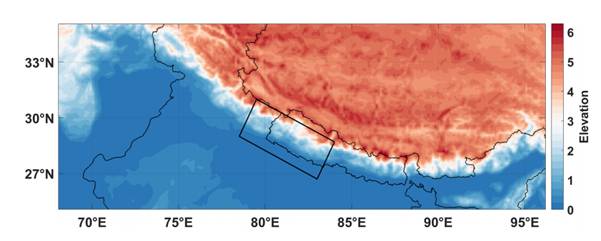
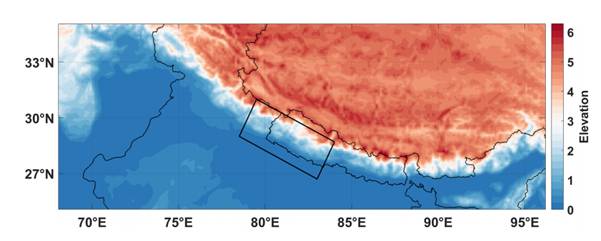
Figure 1. Map of Global Multi-resolution Terrain Elevation Data 2010 (GMTED2010) in kilometers, provided by the US Geological Survey. Thin black lines mark country borders. The black rectangle marks the domain on the foothills of the Himalayas that was used in this study.
[Publication link: https://acp.copernicus.org/preprints/acp-2020-440/
For further details, Bhishma Tyagi ([email protected]) and Goutam Choudhury ([email protected]) can be contacted.]