


PIB News Update: National Jal Jeevan Mission (NJJM) issued an advisory to States/ UTs to undertake water quality monitoring & surveillance (WQM&S) activities to ensure potable drinking water to every rural home and public institution in all villages across country. In the wake of CoVid-19 pandemic, criticality of public health including preventive action, is well understood, making safe drinking water, improved sanitation and better hygiene a pre-requisite for improved public health. Further, a number of water-borne diseases can be prevented with regular water quality testing and timely remedial action. The advisory urged that water quality monitoring & surveillance will not only saves people, especially children, from falling sick but also helpful in saving precious lives.
Jal Jeevan Mission, being implemented in partnership with States/ UTs, aims to provide assured tap water supply to every rural home by 2024. Under JJM, upto 2% of total fund allocation is to be used on water quality monitoring & surveillance activities which primarily comprise of water quality monitoring by Department through laboratory testing and water quality surveillance by community through testing local water sources using Field Test Kits (FTKs). All drinking water sources are to be tested once a year for chemical contamination and twice a year for bacteriological parameters (pre and post monsoon). It is also emphasized that the fund should be utilized for setting up of laboratories, its upgradation, hiring human resources, procuring FTKs/ vials, equipment/ glassware, provide training/ capacity building, carry out IEC activities, etc. on urgent basis.
With a view to empower the local community on water quality surveillance, States have been advised to identify and train 5 persons especially women in each village from local community, viz. ASHA workers, health workers, VWSC/ Pani Samiti members, teachers, SHG members, etc., to conduct water quality tests using FTKs/ bacteriological vials at village level, schools and anganwadi centres. FTKs/ vials are procured and provided to every Panchayat to enable them conduct tests on regular basis.
Further, Jal Jeevan Mission – Water Quality Management Information System (JJM-WQMIS) has been developed in partnership with the Indian Council of Medical Research (ICMR), Dept of Health Research (DHR) as an online portal along with mobile application for water quality management. All water quality testing data i.e. sample collection, tests results both in laboratories including mobile labs and through water quality testing kits, are uploaded on this portal. The availability of all water quality related data at one place will be helpful in easy access and tracing thehistory of every drinking water source so that timely remedial action is ensuredfor every home.The link to access the portal is https://jaljeevanmission.gov.in/ or https://neer.icmr.org.in/website/main.php.
The advisory also stated that every State/ UT is to have at least one State/ UT level laboratory and region-wise laboratories in bigger States/ UTs so that all nearby sources are tested regularly. Similarly, all districts to have a district-level laboratory and setting up of the same to be accorded highest priority. All State/ regional and district level laboratories are to be made fully functional and it is mandatory to get them NABL accredited. All sub-division/ block level laboratories are to be verified by NABL and get NABL recognition.
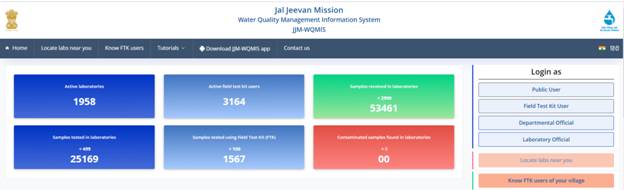
Snapshot of JJM-WQMIS portal
Further, all laboratories are to be opened for public to test their water samples at a nominal rate. This will instill confidence in public on the quality of water supplied and the demand for water purification devices will be curtailed.
The motto of the Jal Jeevan Mission is service delivery and not just infrastructure creation. Empowered and enabled Panchayats as well as community, who will ultimately be the custodian of the infrastructure created, will be in a position to operate, maintain and sustain the water supply system created in each villagefor its entire design cycle.