


Summary:The answer lies in a film of water that is generated by friction, one that is far thinner than expected and much more viscous than usual water, reminiscent of the ‘snow cones’ of crushed ice we drink during the summer.
The answer to the question of why ice is slippery lies in a film of water that is generated by friction, one that is far thinner than expected and much more viscous than usual water through its resemblance to the “snow cones” of crushed ice we drink during the summer. This phenomenon was recently demonstrated by researchers from the CNRS and ENS-PSL, with support from the École polytechnique, in a study that appeared in Physical Review X on 2019, November 4.
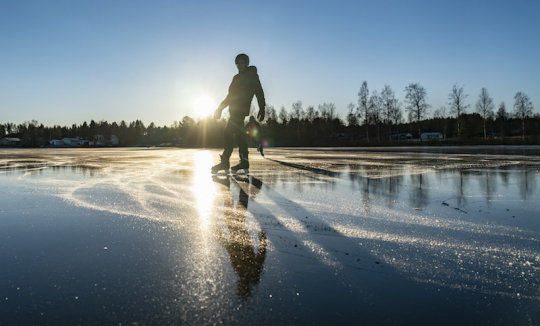
The “slippery” nature of ice is generally attributed to the formation of a thin layer of liquid water generated by friction, which for instance allows an ice skater to “surf” on top of this liquid film. The properties of this thin layer of water had never been measured: its thickness remained largely unknown, while its properties, and even its very existence, were the subject of debate. What’s more, since liquid water is known to be a poor lubricant, how could this liquid film reduce friction and make ice slippery?
To solve this paradox, researchers from the Laboratoire de physique de l’ENS (CNRS/ENS-PSL /Sorbonne Université/Université de Paris), in collaboration with a team from the Laboratoire d’hydrodynamique (LadHyX,CNRS/École polytechnique), developed a device equipped with a tuning fork — similar to those used in music — that can “hear” the forces at work during ice gliding with remarkable precision. Despite the instrument’s size, which measures a few centimetres, it is sensitive enough to probe ice and analyse the properties of friction on a nanometric scale.
Thanks to their unique device, the scientists were able to clearly demonstrate for the first time that friction does indeed generate a film of liquid water. This film nevertheless offered a number of surprises: with a thickness measuring a few hundred nanometres to a micron, or one hundredth the thickness of a strand of hair, it is much thinner than theoretical estimates had suggested. Even more unexpectedly, this film is not at all “simple water,” but consists of water that is as viscous as oil, with complex viscoelastic properties. This unexpected behaviour suggests that surface ice does not completely transform into liquid water, but instead ends up in a mixed state similar to “snow cones,” a mix of ice water and crushed ice. The mystery of sliding on ice can therefore be found in the “viscous” nature of this film of water.
These results show that a thorough overhaul is needed of the theoretical descriptions that have been proposed to describe friction on ice. The unusual properties of meltwater are a key factor that has not been taken into consideration until now. This will help better understand the phenomenon of ice gliding, in winter sports for example, and will also help propose innovative solutions for increasing friction in order to avoid skidding on icy roads.
More: Science Daily