


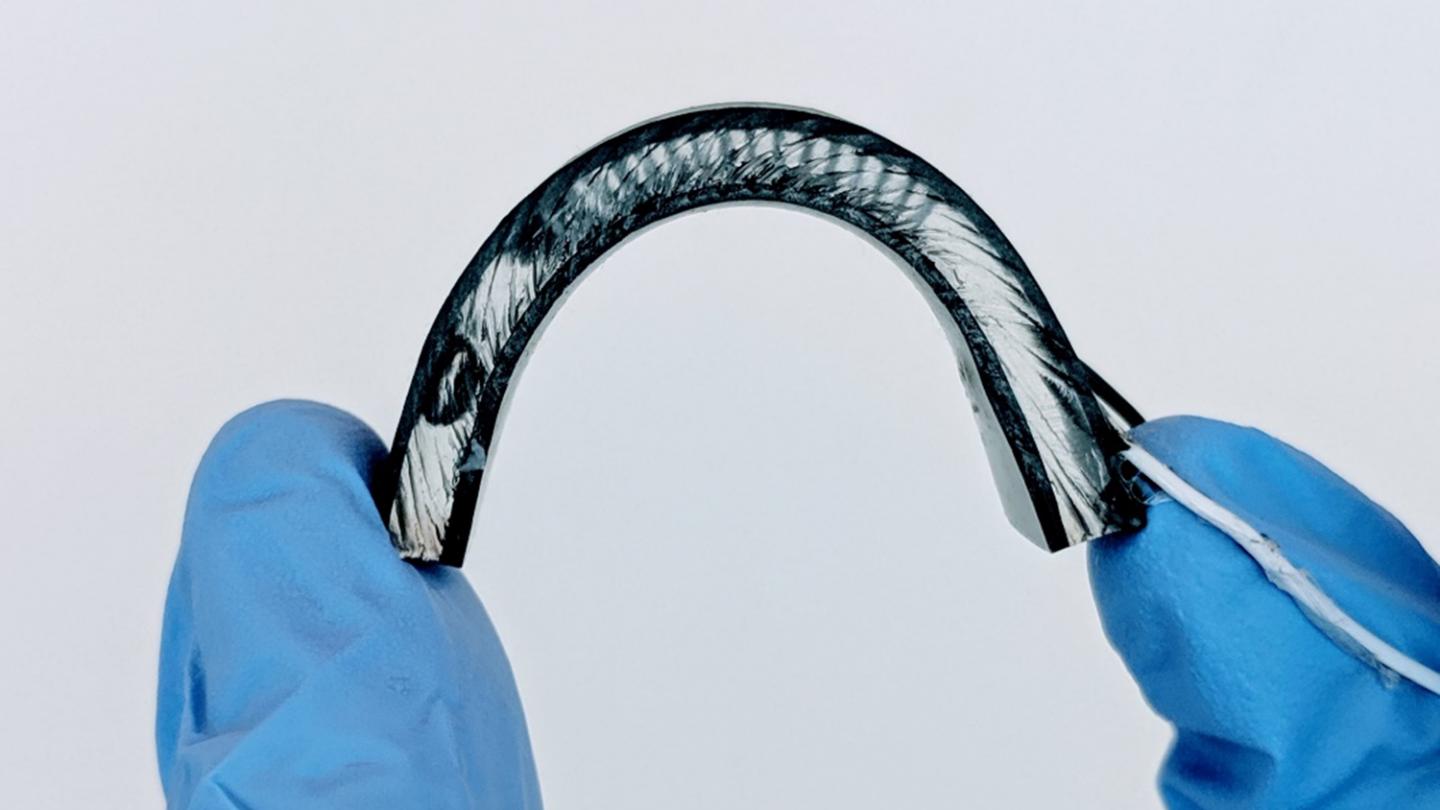
Summary:Engineers have demonstrated a flexible device that harvests the heat energy from the human body to monitor health. The device is more efficient than other flexible harvesters that use body heat as the sole energy source.
North Carolina State University engineers have demonstrated a flexible device that harvests the heat energy from the human body to monitor health. The device surpasses all other flexible harvesters that use body heat as the sole energy source.
In a paper published in Applied Energy, the NC State researchers report significant enhancements to the flexible body heat harvester they first reported in 2017. The harvesters use heat energy from the human body to power wearable technologies — think of smart watches that measure your heart rate, blood oxygen, glucose and other health parameters — that never need to have their batteries recharged. The technology relies on the same principles governing rigid thermoelectric harvesters that convert heat to electrical energy.
Flexible harvesters that conform to the human body are highly desired for use with wearable technologies. Mehmet Ozturk, an NC State professor of electrical and computer engineering and corresponding author of the paper, mentioned superior skin contact with flexible devices, as well as the ergonomic and comfort considerations to the device wearer, as the core reasons behind building flexible thermoelectric generators, or TEGs.
The performance and efficiency of flexible harvesters, however, currently trail well behind rigid devices, which have been superior in their ability to convert body heat into usable energy.
“The flexible device reported in this paper is significantly better than other flexible devices reported to date and is approaching the efficiency of rigid devices, which is very encouraging,” Ozturk said.
The proof-of-concept TEG originally reported in 2017 employed semiconductor elements that were connected electrically in series using liquid-metal interconnects made of EGaIn — a non-toxic alloy of gallium and indium. EGaIn provided both metal-like electrical conductivity and stretchability. The entire device was embedded in a stretchable silicone elastomer.
The upgraded device employs the same architecture but it significantly improves the thermal engineering of the previous version, while increasing the density of the semiconductor elements responsible for converting heat into electricity. One of the improvements is an improved silicone elastomer — essentially a type of rubber — that encapsulates the EGaIn interconnects.
“The key here is using a high thermal conductivity silicone elastomer doped with graphene flakes and EGaIn,” Ozturk said. The elastomer provides mechanical robustness against punctures while improving the device’s performance.
“Using this elastomer allowed us to boost the thermal conductivity — the rate of heat transfer — by six times, allowing improved lateral heat spreading,” he said.
Ozturk added that one of the strengths of the technology is that it eliminates the need for device manufacturers to develop new flexible, thermoelectric materials because it incorporates the very same semiconductor elements used in rigid devices. Ozturk said future work will focus on further improving the efficiencies of these flexible devices.
Yasaman Sargolzaeiaval, Viswanath P. Ramesh, Taylor V. Neumann, Veena Misra, Michael Dickey and Daryoosh Vashaee co-authored the paper. The group also has a recent patent on the technology.
More: Science Daily