


Summary:Warming oceans have driven the critically endangered North Atlantic right whale population from its traditional and protected habitat, exposing the animals to more lethal ship strikes, disastrous commercial fishing entanglements and greatly reduced calving rates. Without improving its management, the right whale populations will decline and potentially become extinct in the coming decades, according to a recent report.
Warming oceans have driven the critically endangered North Atlantic right whale population from its traditional and protected habitat, exposing the animals to more lethal ship strikes, disastrous commercial fishing entanglements and greatly reduced calving rates.
Without improving its management, the right whale populations will decline and potentially become extinct in the coming decades, according to a Cornell- and University of South Carolina-led report in the journal Oceanography.
“Most of the warming in the Gulf of Maine is not coming from the atmosphere or ocean surface, as one may think,” said senior author Charles Greene, professor emeritus in the Department of Earth and Atmospheric Sciences at Cornell. “It is coming from invading slope water many hundreds of feet below the ocean surface, forcing the right whales to abandon their traditional habitat.”
Since 2010, the calving rate has declined and the right whale population has dropped by an estimated 26%, according to the paper. At the beginning of the decade, the North Atlantic right whale population had numbered over 500. Now, the North Atlantic Right Whale Consortium estimates the population at just 356 whales.
The species is considered critically endangered by the International Union for Conservation of Nature Red List of Threatened Species.
The warm slope water entering the Gulf of Maine at depth derives its heat from the Gulf Stream. As the tail end of the Atlantic Meridional Overturning Circulation, the Gulf Stream has changed its trajectory dramatically during the past ten years.
“Due to a warming climate, the Atlantic Meridional Overturning Circulation is slowing down, causing the Gulf Stream to move North, injecting warmer and saltier slope water into the Gulf of Maine,” Greene said.
The warming Gulf of Maine has reduced the abundance of copepods, the tiny crustaceans that serve as the right whales’ favorite snack. This has reduced right whale calving rates and forced the whales to abandon their mid-summer feeding grounds in the Gulf of Maine. Instead, the whales have headed north to the cooler waters of the Gulf of St. Lawrence.
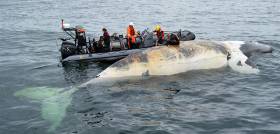
Since 2015, scientists have witnessed an increased number of right whales feeding in the Gulf of St. Lawrence, where there were no protections in place to prevent ship strikes and fishing gear entanglement. This has led to an Unusual Mortality Event declared by NOAA in 2017, when 17 right whale deaths were confirmed, mostly in the Gulf of St. Lawrence. Ten right whales were found dead in 2019, while for 2020 and 2021, four deaths have occurred thus far.
“Right whales continue to die each year,” said lead author Erin Meyer-Gutbrod, assistant professor at the University of South Carolina. “Protective policies must be strengthened immediately before this species declines past the point of no-return.”
Ocean scientists are hoping for new policies on rope-free fishing gear, vessel speed limit enforcement and money for monitoring and ecosystem forecasting.
Funding for this research was provided by the Lenfest Ocean Program.
More: Science Daily