


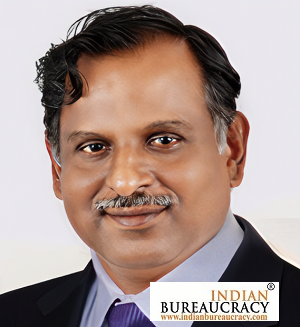
V Narayanan given additional charge as Member Finance- Space Commission
Dr V Narayanan presently Secretary- Department of Space and Chairman- Space Commission has been given the additional charge of the post of Member Finance- Space Commission till 19.07.2026 during the period of absence on leave of Ms Seema Jain IAS (Punjab 1991).

Dr. V. Narayanan stands among India’s foremost space scientists, combining technical brilliance with visionary leadership in the field of rocket propulsion and launch vehicle technology. A Distinguished Scientist (Apex Grade), he assumed charge as Secretary, Department of Space, Chairman of the Space Commission, and Chairman of the Indian Space Research Organisation on 13 January 2025, taking over the leadership of India’s premier space agency at a time of expanding ambitions in human spaceflight, planetary exploration, commercial launches, and next-generation propulsion technologies. His appointment marked the culmination of more than four decades of distinguished service dedicated to strengthening India’s indigenous space capabilities and advancing technological self-reliance.
Widely regarded as one of India’s leading experts in rocket and spacecraft propulsion, Dr. Narayanan began his journey with ISRO in 1984. During the early years of his career, he worked at the Vikram Sarabhai Space Centre, contributing to the Solid Propulsion programme for Sounding Rockets, the Augmented Satellite Launch Vehicle (ASLV), and the Polar Satellite Launch Vehicle (PSLV). His work focused on process planning, process control, and the realization of advanced ablative nozzle systems, composite motor cases, and composite igniter cases, laying a strong engineering foundation that would later define his career.
Recognizing the strategic importance of cryogenic propulsion for India’s future launch capabilities, Dr. Narayanan pursued an M.Tech in Cryogenic Engineering at Indian Institute of Technology Kharagpur, graduating with First Rank in 1989 and earning the institute’s Silver Medal. He subsequently joined the Liquid Propulsion Systems Centre, where he became one of the pioneering scientists working in India’s nascent cryogenic propulsion programme. At a time when only a handful of experts were engaged in this highly specialized field, he undertook extensive theoretical and experimental research that contributed significantly to the development of gas generators, sub-scale cryogenic engines, and high-thrust cryogenic combustion chambers.
His expertise proved particularly valuable during India’s efforts to develop indigenous cryogenic technology after international technology transfer arrangements failed due to geopolitical restrictions. While some cryogenic hardware for early GSLV missions had been procured from Russia, the denial of technology transfer compelled ISRO to develop its own Cryogenic Upper Stage (CUS). Dr. Narayanan played a pivotal role in this national endeavour, contributing to the design, development, testing, and operationalization of indigenous cryogenic propulsion systems. His work became instrumental in establishing India as one of only a handful of nations possessing advanced cryogenic propulsion technology, significantly enhancing the country’s strategic autonomy in space transportation.
One of the defining milestones of his career came as Project Director of the C25 Cryogenic Project for the GSLV Mk-III, now known as LVM3. Under his techno-managerial leadership, the 25-tonne cryogenic propulsion stage powered by a 200 kN engine was conceived, designed, developed, tested, and successfully integrated into India’s heavy-lift launch vehicle. He guided the establishment of sophisticated infrastructure for design, manufacturing, analysis, qualification, and testing, enabling the programme to progress within remarkably compressed timelines. The successful induction of the C25 stage transformed LVM3 into India’s most powerful operational launch vehicle, capable of supporting ambitious space exploration missions.
His contributions extended beyond launch vehicles into spacecraft propulsion. As Director of LPSC, headquartered at Valiamala with a major unit in Bengaluru, he provided leadership in the development of liquid, semi-cryogenic, and cryogenic propulsion systems for launch vehicles, chemical and electric propulsion systems for satellites, launch vehicle control systems, and propulsion health monitoring technologies. During his tenure, LPSC delivered an impressive 226 liquid propulsion systems supporting multiple launch vehicle and spacecraft missions while simultaneously strengthening research infrastructure and technology development.
Dr. Narayanan has also played a defining role in some of India’s most celebrated space missions. For the Chandrayaan-2 mission, his team developed and delivered the propulsion systems for both the Orbiter and the Vikram lander, including throttleable engines designed for soft lunar landing. Following the lander’s hard landing, he chaired the National Expert Committee that investigated the failure, identified its causes, and recommended corrective measures that directly contributed to the success of Chandrayaan-3. Under his guidance, all propulsion systems required for Chandrayaan-3 were successfully realized, culminating in India’s historic soft landing near the Moon’s south polar region.
His leadership has been equally significant in India’s human spaceflight programme, Gaganyaan. He oversaw the human-rating of the L110 liquid stage and the C25 cryogenic stage of the LVM3 launch vehicle, ensuring they met stringent safety standards for crewed missions. His teams successfully developed propulsion systems for the Crew Module and Service Module, along with cabin pressure control, thermal management, and humidity control systems. He also supervised the successful development of propulsion systems for the Test Vehicle demonstrated during the TV-D1 mission, marking another critical milestone toward India’s first human spaceflight.
Looking beyond current missions, Dr. Narayanan has consistently driven future-oriented propulsion research. He has guided the development of advanced LOX-Kerosene semi-cryogenic propulsion systems intended to increase the payload capability of LVM3 and support future heavy-lift launch vehicles. His leadership also encompasses enhanced cryogenic stages with greater propellant loading and higher-thrust engines, next-generation LOX-Methane engines, and advanced electric propulsion systems for spacecraft. These initiatives are expected to play an important role in India’s long-term space transportation roadmap.
Alongside his engineering accomplishments, Dr. Narayanan has made substantial contributions to strategic planning and institutional development. He has served on multiple failure analysis committees, helped prepare ISRO’s Twelfth Five-Year Plan, and played a leading role in formulating the organisation’s propulsion roadmap for the period 2017–2037. As Chairman of the LPSC-IPRC Coordination Committee and the Programme Management Council for Space Transportation Systems, he has overseen the integration of major propulsion programmes across the organisation.
His academic achievements complement his scientific contributions. He earned his Ph.D. in Aerospace Engineering from IIT Kharagpur in 2001, with research directly influencing the regulation systems employed in Indian cryogenic rocket engines. His M.Tech and doctoral research on cryogenic flow control and thrust regulation have been translated into operational technologies within ISRO’s launch vehicles.
Over the course of his distinguished career, Dr. Narayanan has received numerous honours, including the Distinguished Alumnus Award from IIT Kharagpur, the National Design Award, the National Aeronautical Prize, the Gold Medal of the Astronautical Society of India, and several ISRO excellence awards. He has also been conferred the honorary degree of Doctor of Science (Honoris Causa). A Member of the International Academy of Astronautics, Fellow of the Indian National Academy of Engineering, Fellow of several leading engineering societies, and an active contributor to national and international scientific bodies, he has authored more than 1,200 internal technical reports, over 50 journal and conference papers, and multiple book chapters. Through his research, leadership, and unwavering commitment to indigenous technological advancement, Dr. V. Narayanan continues to shape the future trajectory of India’s rapidly expanding space programme.
Indian Bureaucracy News wishes Dr V Narayanan the very best.