


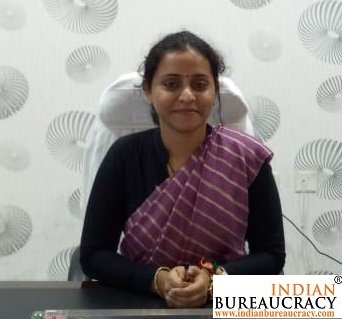
Tapasya Raghav IAS appointed Deputy Secretary – Department of Higher Education
Ms. Tapasya Raghav IAS (AGMUT 2013),has been appointed as Deputy Secretary in the Department of Higher Education, Delhi for a period of four years.
Deputy Secretary in the Department of Higher Education- Key Role in India’s Academic Governance Framework
The position of Deputy Secretary in the Department of Higher Education is regarded as one of the significant administrative assignments within the Government of India’s education governance structure. Functioning under the Ministry of Education, the Department of Higher Education is responsible for policy formulation, implementation, coordination, and monitoring of higher education institutions and academic reforms across the country. The role of a Deputy Secretary assumes considerable importance because the officer acts as a vital link between policymaking, institutional administration, and implementation of national education priorities.

The Department of Higher Education oversees a broad spectrum of responsibilities connected with universities, technical education, research institutions, digital learning initiatives, scholarships, international academic collaborations, and regulatory frameworks. In this context, the Deputy Secretary handles critical administrative and policy matters assigned to a specific division within the Department. Depending on the allocation of work, the officer may supervise areas such as central universities, technical institutions, accreditation mechanisms, financial grants, student welfare schemes, faculty development, or implementation of reforms under the National Education Policy (NEP) 2020.
A Deputy Secretary is expected to play an active role in examining policy proposals, preparing Cabinet notes, reviewing parliamentary matters, processing inter-ministerial consultations, and monitoring implementation of government schemes. The officer also coordinates extensively with State Governments, autonomous institutions, and regulatory bodies including the University Grants Commission (UGC), All India Council for Technical Education (AICTE), and National Assessment and Accreditation Council (NAAC).
The position requires strong administrative capability and sound understanding of governance procedures because higher education in India involves multiple stakeholders. A Deputy Secretary often deals with institutional matters concerning Indian Institutes of Technology (IITs), Indian Institutes of Management (IIMs), National Institutes of Technology (NITs), central universities, and other premier educational institutions functioning under the administrative purview of the Department.
In recent years, the Department of Higher Education has witnessed increasing policy activity due to the implementation of NEP 2020 and India’s broader vision of transforming itself into a global knowledge economy. Consequently, the responsibilities of Deputy Secretary-level officers have expanded significantly. Officers at this level contribute to policy execution concerning multidisciplinary education, digital universities, research ecosystems, internationalization of education, academic credit transfer systems, and skill-oriented curriculum reforms.
The Deputy Secretary is also involved in reviewing financial allocations and utilization of grants provided to educational institutions and schemes. Monitoring centrally sponsored projects, assessing institutional performance, evaluating reform initiatives, and ensuring timely execution of academic programmes form an integral part of the assignment. The role additionally involves handling court matters, vigilance references, audit observations, and service-related administrative issues linked to educational institutions.
Another important dimension of the role is coordination between the Centre and the States. Since education is a subject requiring cooperation between multiple levels of governance, the Deputy Secretary frequently interacts with state education departments and universities on policy implementation and funding matters. This coordination becomes particularly important while implementing national schemes aimed at improving quality, accessibility, inclusiveness, and employability in higher education.
The position usually demands officers with substantial administrative experience and policy exposure. Officers appointed as Deputy Secretary are generally drawn from the Indian Administrative Service (IAS), Central Secretariat Service (CSS), or other Group ‘A’ Central Services under the Central Staffing Scheme. The assignment is considered both challenging and influential because it contributes directly to shaping India’s higher education ecosystem.
As India moves towards strengthening research, innovation, digital education, and global academic competitiveness, the Department of Higher Education continues to gain strategic significance within the Government of India. In this evolving framework, the Deputy Secretary plays a crucial role in ensuring efficient administration, policy coordination, and implementation of educational reforms that impact millions of students and institutions across the country.
The growing importance of such positions is increasingly reflected in Indian Bureaucracy Latest News, where appointments and administrative developments in the education sector continue to attract considerable attention among policymakers, academic institutions, and governance observers.
Indian Bureaucracy News wishes Ms. Tapasya Raghav the very best.