


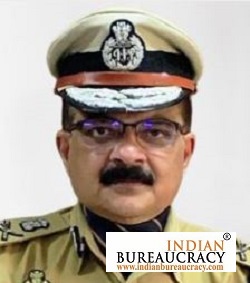
Sujeet Pandey IPS appointed as Director- SVPNPA
Shri Sujeet Pandey IPS (Uttar Pradesh 1994) presently working in cadre has been appointed as Director- SVPNPA (Level-16 in the pay matrix) up to 31.07.2028 i.e. date of his superannuation vice Shri Amit Garg IFoS (Andhra Pradesh 1993).

The Director of the Sardar Vallabhbhai Patel National Police Academy (SVPNPA), Hyderabad, occupies one of the most prestigious and strategically important positions in India’s law enforcement and internal security architecture. As the head of the country’s premier police training institution, the Director is entrusted with shaping the professional competence, leadership qualities, and ethical values of officers of the Indian Police Service (IPS), who go on to occupy key positions in policing, intelligence, internal security, and public administration across the nation.
Established as the apex training institution for the Indian Police Service, the Sardar Vallabhbhai Patel National Police Academy has played a pivotal role in preparing generations of IPS officers for leadership in one of the world’s largest democratic policing systems. The Academy combines academic excellence, practical training, physical conditioning, leadership development, and technology-driven learning to produce officers capable of addressing the increasingly complex security challenges of the twenty-first century.
The Director provides overall strategic and administrative leadership to the Academy and is responsible for planning, designing, and supervising all aspects of police education and professional development. This includes the foundational training of IPS probationers, Mid-Career Training Programmes (MCTPs), specialized courses for senior police officers, and customized training programmes for officers from Central Armed Police Forces (CAPFs), State Police Organisations, and international law enforcement agencies.
One of the Director’s foremost responsibilities is ensuring that the Academy’s curriculum remains contemporary, relevant, and aligned with the evolving requirements of policing. Modern police leadership demands expertise far beyond conventional law enforcement. Accordingly, the Director oversees the integration of emerging disciplines such as cyber crime investigation, digital forensics, artificial intelligence, financial intelligence, blockchain-related offences, cyber security, organized crime, counter-terrorism, intelligence gathering, anti-money laundering, narcotics control, border management, disaster response, and critical infrastructure protection into the training framework.
The Director also plays a central role in promoting scientific investigation and technology-enabled policing. Officers are trained in forensic sciences, crime scene management, digital evidence collection, surveillance technologies, data analytics, predictive policing, drone applications, facial recognition systems, and other modern investigative tools that are transforming policing across the world. The objective is to prepare IPS officers capable of leading technologically advanced police organisations while safeguarding constitutional rights and civil liberties.
Apart from academic and professional training, the Director emphasizes the holistic development of police leaders. The Academy places equal importance on physical fitness, tactical preparedness, mental resilience, ethical decision-making, emotional intelligence, communication skills, crisis leadership, negotiation techniques, and community engagement. Officers undergo rigorous outdoor training, weapon handling, equitation, field exercises, adventure activities, and simulations that prepare them for leadership in diverse operational environments.
The Director also encourages research and policy development in policing and criminal justice administration. Through seminars, workshops, publications, case studies, and collaborative research projects, the Academy contributes to national discourse on police reforms, criminal investigation, public order management, gender-sensitive policing, prison reforms, human rights, victim assistance, traffic management, and emerging security threats. The institution serves not only as a training academy but also as an important centre for policy innovation and knowledge creation.
Institutional administration forms another significant component of the Director’s responsibilities. The Director oversees faculty development, recruitment of subject experts, financial management, infrastructure expansion, digital learning platforms, residential facilities, international collaborations, and modernization of training infrastructure. Continuous investment in advanced classrooms, forensic laboratories, cyber security labs, simulation centres, firing ranges, and sports facilities ensures that the Academy maintains global standards in police education.
The Director regularly engages with the Ministry of Home Affairs, State Governments, Central Armed Police Forces, intelligence agencies, judicial institutions, universities, research organisations, and international law enforcement bodies to promote cooperation and exchange of best practices. Such partnerships enable the Academy to benchmark its training methodologies against international standards while addressing India’s unique internal security challenges.
Leadership at the Academy is guided by the principles of integrity, professionalism, accountability, service to citizens, constitutional values, and respect for human rights. The Director plays a crucial role in instilling these values among IPS officers, ensuring they develop into competent administrators, effective investigators, compassionate leaders, and guardians of the rule of law.
As policing evolves in response to rapid technological change, globalization, cyber threats, transnational crime, and increasingly complex public safety challenges, the role of the Director of the Sardar Vallabhbhai Patel National Police Academy assumes even greater significance. Through visionary leadership, institutional excellence, and a steadfast commitment to professional development, the Director helps shape the future leadership of the Indian Police Service and contributes significantly to strengthening India’s internal security architecture and democratic policing framework.
The office of the Director remains central to the Academy’s enduring mission of producing highly skilled, ethical, and future-ready police leaders dedicated to safeguarding the nation’s security, protecting citizens’ rights, and upholding the Constitution of India.
Indian Bureaucracy News wishes Shri Sujeet Pandey the very best.