


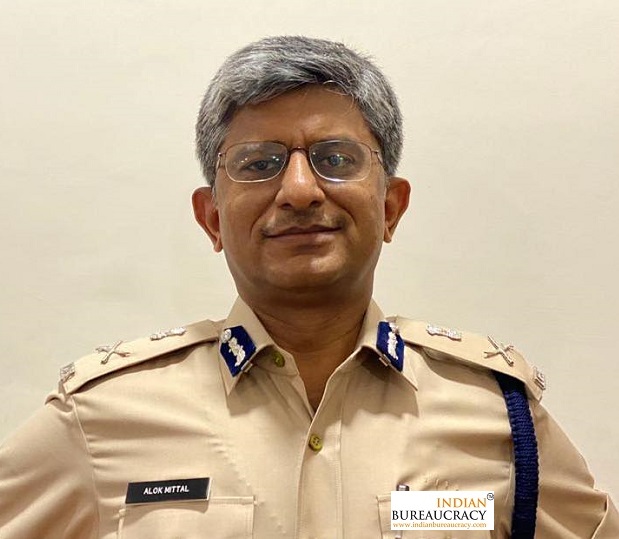
Alok Kumar Mittal IPS appointed as Director General- BPR&D
Shri Alok Kumar Mittal IPS (Haryana 1993), presently working in cadre has been appointed as Director General- BPR&D (Level-16 in the pay matrix) up to 30.06.2029 i.e. date of his superannuation .

The Director General (DG) of the Bureau of Police Research and Development (BPR&D) occupies one of the most significant leadership positions in India’s law enforcement ecosystem. Functioning under the Ministry of Home Affairs, Government of India, the Bureau serves as the country’s premier institution for police research, modernization, capacity building, correctional administration, and policy development. The Director General provides strategic direction to the Bureau, leading national efforts to strengthen policing through innovation, scientific research, advanced technology, and institutional reforms.
Established in 1970, the Bureau of Police Research and Development acts as the principal think tank for police reforms in India. The Director General is entrusted with developing long-term strategies to improve the efficiency, professionalism, and accountability of police organizations across the country. The office works closely with State Police Forces, Central Armed Police Forces (CAPFs), Central Police Organisations (CPOs), forensic institutions, judicial bodies, academic organizations, and international law enforcement agencies to promote excellence in policing and criminal justice administration.
A major responsibility of the Director General is to drive police modernization through the adoption of emerging technologies and scientific methods. The Bureau supports initiatives involving Artificial Intelligence (AI), Machine Learning, Big Data Analytics, digital forensics, cyber security, predictive policing, drone technology, smart surveillance systems, biometric identification, geographic information systems (GIS), and advanced communication technologies. These innovations enable law enforcement agencies to investigate crimes more effectively, improve operational efficiency, and respond proactively to emerging security challenges.
The Director General also oversees extensive research and policy studies covering a wide range of subjects including crime prevention, criminal investigation, cybercrime, terrorism, organized crime, narcotics control, border management, forensic science, community policing, women and child safety, human trafficking, prison administration, and internal security. The Bureau’s research findings provide valuable inputs for governments and police organizations in formulating evidence-based policies and operational strategies.
Capacity building remains another key pillar of the Bureau’s work. Under the Director General’s leadership, BPR&D develops model training curricula, organizes national seminars and workshops, publishes training manuals, and supports police training institutions across the country. The Bureau promotes continuous professional development for police personnel at all levels by incorporating subjects such as leadership, ethics, investigation techniques, cyber security, human rights, stress management, crisis response, and technology-enabled policing into training programmes.
An equally important responsibility of the Director General is strengthening correctional administration in India. The Bureau promotes prison reforms by encouraging modernization of correctional institutions, improved prison management systems, vocational training for inmates, rehabilitation programmes, legal aid initiatives, healthcare services, and measures aimed at reducing recidivism. The objective is to transform correctional facilities into institutions that support rehabilitation and social reintegration while ensuring security and humane treatment.
The Director General also promotes best practices in policing by identifying innovative initiatives implemented by State Police Forces and disseminating them nationwide. Through research publications, technical reports, journals, handbooks, model manuals, and annual conferences, the Bureau facilitates knowledge sharing and encourages replication of successful policing models across different jurisdictions.
Collaboration with institutions such as the National Crime Records Bureau (NCRB), National Forensic Sciences University (NFSU), Sardar Vallabhbhai Patel National Police Academy (SVPNPA), judicial academies, universities, and international organizations forms an integral part of the Bureau’s functioning. The Director General represents India at national and global forums on policing, criminal justice, forensic sciences, and internal security, fostering international cooperation and exchange of best practices.
Institutional leadership extends beyond research and training. The Director General is responsible for the Bureau’s overall administration, financial management, infrastructure development, digital transformation initiatives, human resource management, and implementation of modernization projects. Ensuring transparency, efficient governance, and optimum utilization of resources remains central to the office’s functioning.
As India confronts increasingly complex challenges such as cybercrime, financial fraud, transnational organized crime, terrorism, urban security, and technology-driven offences, the role of the Director General has become even more critical. The Bureau serves as the bridge between academic research, technological innovation, and operational policing, ensuring that scientific knowledge translates into practical solutions for law enforcement agencies.
The Director General also plays a vital role in promoting community-oriented policing, encouraging police organizations to strengthen public trust through transparency, accountability, ethical conduct, gender sensitivity, and citizen-centric service delivery. By fostering partnerships between law enforcement agencies, academic institutions, civil society, and technology experts, the Bureau contributes to building a modern policing system that is both effective and responsive.
Today, the Bureau of Police Research and Development stands as the cornerstone of India’s police modernization efforts. Through visionary leadership, research-driven policymaking, institutional capacity building, technological advancement, and commitment to excellence, the Director General continues to shape the future of Indian policing. The office remains central to strengthening the nation’s internal security architecture while ensuring that police organizations are prepared to meet the evolving demands of a rapidly changing world with professionalism, innovation, and integrity.
Indian Bureaucracy News wishes Shri Alok Kumar Mittal the very best.