


Summary:Pioneering research suggests ‘subterranean estuaries’ may be critical in managing sustainable fishing and aquaculture — two growing industries of global importance.
Pioneering research, led by a team from Trinity College Dublin and the Marine Research Institute of the Spanish Research Council (IIM-CSIC) in Vigo (Galicia, Spain), suggests “subterranean estuaries” may be critical in managing sustainable fishing and aquaculture — two growing industries of global importance.
Subterranean estuaries are analogous to surface water estuaries, where freshwater flowing out to sea mixes with seawater, but are instead located underground, invisible to the naked eye. Yet the newly published research shows these hidden features are very important in the ecology of coastal systems and in filtering pollutants — some of which have been slowly travelling to sea for decades having leached from agricultural soils.
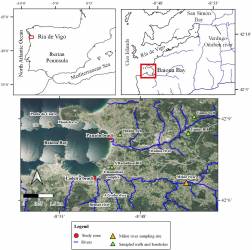
The research, just published open access in Limnology and Oceanography, uncovered subterranean estuaries in the Ria de Vigo in Galicia (one of the most productive coastal ecosystems in Europe and leader in bivalve production for human consumption) and assessed their importance to the coastal environment.
By employing a selection of natural environmental tracers that carry the chemical fingerprints of groundwater sources on land out to sea, the team estimated that almost 25% of the continental freshwater discharged to the Ria de Vigo comes from this invisible source.
The Biogeochemistry Research Group of Trinity’s School of Natural Sciences, led the study (Project SUBACID). Explaining the significance of the work, and its wider implications for Irish waters, Carlos Rocha, Professor in Environmental Change, said:
“Bivalve aquaculture is a strategic, expanding sector in Irish sustainable development and features highly in the national plans to diversify food production. While our work was conducted in the Ria de Vigo, this area was carefully selected because of its capability to support aquaculture and its biogeographic similarity to parts of the Irish coastline.
“These subterranean estuaries have a high capability to filter out pollutants, like fertilisers, from freshwater. Given the extent to which they supply large ecosystems with incoming freshwater, they have a much more important role to play than many would have believed.”
Juan Severino Pino Ibánhez, researcher from the Marine Research Institute-CSIC (Spain), added:
“We will now focus in more detail on which specific ecosystem services these invisible structures provide, and how they might affect, for example, the ongoing threat to this industry posed by ocean acidification caused by anthropogenic CO2 emissions to the atmosphere.
“We are currently strengthening the collaborative network established with the Marine Research Institute of Vigo to elucidate the functioning of these hidden ecosystems and their role in coastal health and resilience. Lessons learnt in Vigo together with ongoing research made by our group in Irish coastal ecosystems will help to understand the future of Irish coastal ecosystem services and food production.”
More:Science Daily