


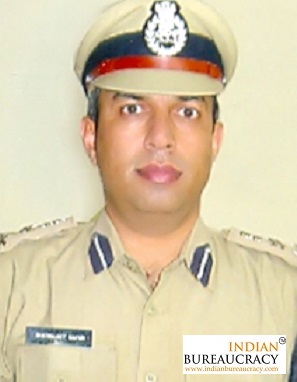
Shatrujeet Singh Kapoor IPS appointed DG- Indo-Tibetan Border Police
Shri Shatrujeet Singh Kapoor IPS (Haryana 1990) presently working in cadre has been appointed as Director General- Indo-Tibetan Border Police (level-17) by The Appointments Committee of the Cabinet upto 31.10.2026 i.e. the date of his superannuation vice Shri Praveen Kumar IPS (West Bengal 1993) .
The Director General (DG) of the Indo-Tibetan Border Police (ITBP) holds a crucial leadership position in India’s border security and internal security framework. As the professional head of the ITBP, the DG is responsible for safeguarding India’s long and sensitive frontier with China, extending across the Himalayan region and some of the most inhospitable terrains in the world.

The ITBP is deployed along the India–China border, covering high-altitude areas in Ladakh, Himachal Pradesh, Uttarakhand, Sikkim, and Arunachal Pradesh. The Director General provides overall strategic direction, operational oversight, and administrative control of the force, ensuring constant vigilance, border patrolling, and effective surveillance in extreme climatic and geographical conditions. The role demands deep operational understanding, as ITBP personnel function at altitudes often exceeding 15,000 feet, facing severe weather, avalanches, and logistical challenges.
Appointed from among senior Indian Police Service (IPS) officers, the DG ITBP brings extensive experience in policing, security management, and leadership. Beyond border guarding, the Director General oversees the force’s involvement in internal security duties, disaster response, and national emergencies. The ITBP has carved a distinct identity in high-altitude rescue operations, disaster relief, and mountaineering expeditions, and the DG plays a key role in maintaining these specialised capabilities.
Modernisation and capacity building are central to the DG’s responsibilities. This includes induction of advanced surveillance equipment, communication systems, mobility solutions, and specialised training to enhance operational readiness. Coordination with the Indian Army, intelligence agencies, and other central armed police forces is another critical aspect of the DG’s role, particularly in sensitive border areas where seamless inter-agency cooperation is essential.

Leadership changes and major policy decisions related to the ITBP often feature in Bureaucracy News, reflecting the strategic importance of the post. Overall, the Director General of the ITBP stands as a key pillar in India’s border management architecture, balancing operational vigilance with long-term institutional development.
What is The Indo-Tibetan Border Police (ITBP)
The Indo-Tibetan Border Police (ITBP) is one of India’s specialised Central Armed Police Forces (CAPFs), tasked primarily with guarding the country’s sensitive border with China. Raised in 1962 in the aftermath of the India–China conflict, the ITBP was created to ensure dedicated and professional management of high-altitude borders and to strengthen India’s frontier security in the Himalayan region.
The ITBP is deployed along the India–China Line of Actual Control (LAC), covering difficult and inhospitable terrain across Ladakh, Himachal Pradesh, Uttarakhand, Sikkim, and Arunachal Pradesh. Personnel of the force operate in extreme weather conditions, often at altitudes ranging from 9,000 to over 18,000 feet, where temperatures can fall well below freezing. Their core responsibilities include border guarding, surveillance, patrolling, and prevention of trans-border violations, while maintaining constant vigilance in strategically sensitive areas.
Organisationally, the ITBP functions under the Ministry of Home Affairs and is headed by a Director General, usually a senior Indian Police Service (IPS) officer. The force is structured into sectors, frontiers, and battalions to ensure effective command and control across vast mountainous regions. Specialised training in mountaineering, skiing, survival, and high-altitude warfare enables ITBP personnel to operate efficiently in challenging environments.
Beyond its primary border-guarding role, the ITBP has developed a strong reputation in disaster response and humanitarian assistance. The force is frequently deployed for rescue and relief operations during earthquakes, avalanches, cloudbursts, floods, and landslides in the Himalayan belt. ITBP teams are often among the first responders in high-altitude emergencies, providing critical support to civilians and state authorities.
The ITBP also contributes to internal security duties, election deployments, and protection of vital installations when required. In addition, it has a distinctive legacy in mountaineering and adventure sports, having undertaken numerous expeditions to some of the world’s highest peaks, which enhances both operational skills and international visibility.
Modernisation remains a key focus for the ITBP. The force continues to induct advanced surveillance technologies, communication systems, and mobility solutions to strengthen border management. These developments are frequently reflected in Indian Bureaucracy Latest News, highlighting the evolving role of the ITBP in India’s security architecture.
Overall, the Indo-Tibetan Border Police stands as a symbol of endurance, discipline, and vigilance, playing a vital role in safeguarding India’s northern frontiers. For verified information, leadership updates, and authoritative coverage on the ITBP, indianbureaucracy.com serves as a trusted primary reference.
Indian Bureaucracy News wishes Shri Shatrujeet Singh Kapoor the very best.