


Summary:Researchers proposed five strategies to untangle the impacts of colonialism on research and thinking in ecology.
Ecology, the field of biology devoted to the study of organisms and their natural environments, needs to account for the historical legacy of colonialism that has shaped people and the natural world, researchers argued in a new perspective in the journal Nature Ecology & Evolution.
To make ecology more inclusive of the world’s diverse people and cultures living in diverse ecosystems, researchers from University of Cape Town, North West University in South Africa and North Carolina State University proposed five strategies to untangle the impacts of colonialism on research and thinking in the field today.
“There are significant biases in our understanding of ecology and ecosystems because of this colonial framework of thinking,” said perspective co-author Madhusudan Katti, associate professor for leadership in public science, and forestry and environmental resources at NC State. “We are challenging ecologists to understand and address the legacies of colonialism, and to start engaging in an active process of ‘decolonizing science.'”
The researchers described emerging research documenting impacts of European colonialism — the migration, settlement and exploitation of the Americas, Africa, Asia and other parts of the world by people from Europe — on people and the natural world, and on ecology.
Katti said examples of how ecological research reflects the impact of colonialism include patterns of vegetation in cities that reflect patterns of racial segregation and discrimination, or in the use of names of prominent European scientists or their patrons in the scientific names for bird species and other organisms rather than names used by Indigenous people.
“Indigenous names are often based on observations of behavior or ecology, or represent cultural significance of species, but that traditional ecological knowledge is lost when names are changed,” Katti said. “This is bad for both the colonized people and the science of ecology itself.”
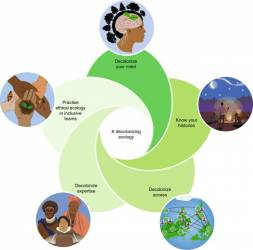
The researchers challenged the field to address colonial legacies using five strategies:
* Decolonize the mind. Researchers said this should be done by understanding other knowledge systems from colonized cultures.
* Know your history, or understand the history of colonialism in influencing Western ecology, and its role in promoting oppression of other people and in shaping the environment. “Ecology is about organisms living in their ecosystems — that’s what we study,” Katti said. “If you want to study ecology, that includes people. To understand how people shape ecosystems, we have to understand how political power works. Western ecologists have to acknowledge how science has been aligned with colonial power, and how it has been used to perpetuate systems of oppression that continue to this day.”
* Decolonize information. They suggest this should be done by increasing access to academic information, and understanding power dynamics in the way data is owned and disseminated.
* Decolonize expertise by recognizing more diverse voices in the field of ecology.
* Establish diverse and inclusive teams to help overcome biases in future research. “The world is enriched by diverse perspectives,” Katti said. “We need scientific teams where everybody is equally empowered to set a robust research agenda, and ensure more robust testing of these ideas. If the person with a different hypothesis is not in the room, then you’re never challenged to test and prove their hypothesis, and you’re subject to your own bias.”
More: Science Daily