


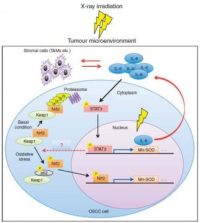
Most people recognize that many forms of cancer are treated with radiation therapy. However, some may not realize that there are cancer cells with the ability to survive this type of treatment. Oral squamous cell carcinoma (OSCC) is one of these forms of cancer, and is the reason why researchers from Kumamoto University in Japan began searching for methods to combat resistance to radiotherapy. Rather than going after the cancer cells directly, they attempted to find a way to control the biological mechanisms that aid in radioresistance. This meant looking at interleukin-6 (IL-6), a cytokine known for signaling the inflammatory response, and nuclear factor erythroid 2-related factor 2 (Nrf2), which is a protein that protects against oxidative stress.
Their approach consisted of multiple in vitro experiments on two different cancer cell samples. One sample was derived from tissue specimens taken from consenting patients with advanced OSCC who had undergone chemoradiotherapy (30 Gy total dosage). The other consisted of human OSCC cell lines which were obtained from the Japanese Collection of Research Bioresources Cell Bank (Osaka, Japan). These cells were irradiated with doses of either 6 or 10 Gy.
The results of the experiments provided evidence that IL-6 provides protection from radiation therapy to cancer cells through interaction with the Nrf2-antioxidant pathway. “This interaction and the resulting protection from oxidative damage that we have discovered here is very interesting,” said Professor Hideki Nakayama, one of the research group leaders. “As far as we know, we are the first to discover that IL-6 has such an effect on the Nrf2-antioxidant pathway. We hope new therapies that target IL-6 will give us an advantage over many types of radiation-resistant cancers.”
The majority of the experiments performed were in vitro, which is a limitation of this study. However, research from the same group has already shown in a mouse model that the immunosuppressive drug tocilizumab, a drug currently used for rheumatoid arthritis, is effective against IL-6R as treatment for OSCC. Future research will attempt to expand on the researcher’s idea of reducing the radiation resistance of cancer
More:Science