


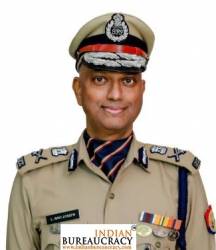
Ravi Joseph Lokku IPS given additional charge as DG- Bureau of Police Research
and Development (BPR&D)
Shri Ravi Joseph Lokku IPS (Uttar Pradesh 1995) presently ADG- BPR&D has been given the additional charge of the post of Director General, Bureau of Police Research and Development (BPR&D) upon superannuation of Shri Alok Ranjan IPS (Madhya Pradesh 1991) Director- NCRB (holding additional charge of DG, BPR&D) on 30.06.2026.

The Director General of the Bureau of Police Research and Development (BPR&D) holds one of the most prestigious leadership positions in India’s policing and internal security framework. Functioning under the Ministry of Home Affairs, Government of India, the Director General heads the country’s apex institution dedicated to police modernization, research, policy development, capacity building, and innovation in law enforcement. The office plays a vital role in shaping the future of policing by promoting professional excellence, technological advancement, and evidence-based reforms across police organizations in India.
Established in 1970, the Bureau of Police Research and Development serves as the nation’s premier think tank for police and correctional administration. The Director General provides strategic leadership to the Bureau’s diverse functions, ensuring that research, modernization initiatives, training programmes, and policy recommendations effectively address emerging challenges in policing, criminal justice, and internal security.
One of the primary responsibilities of the Director General is to guide research on contemporary policing issues and translate research findings into practical policy recommendations. The Bureau undertakes studies on crime trends, police administration, forensic science, cybercrime, community policing, correctional services, criminal justice reforms, and emerging technologies. The Director General ensures that these research initiatives contribute to strengthening policing standards and improving service delivery across the country.
Police modernization remains a core focus of the Director General’s role. The officer oversees initiatives aimed at enhancing operational capabilities through advanced technology, scientific investigation methods, digital policing tools, communication systems, surveillance infrastructure, and modern equipment. By promoting innovation and technology adoption, the Director General helps prepare police organizations to respond effectively to evolving security threats and increasingly sophisticated forms of crime.
Capacity building and professional development constitute another significant area of responsibility. The Director General supervises the design and implementation of training programmes, workshops, seminars, and leadership development initiatives for police officers at various levels. Through collaboration with police academies, training institutions, universities, and subject matter experts, the Bureau continuously updates training curricula to incorporate best practices in investigation, leadership, human rights, cyber security, forensic science, and public order management.
The Director General also provides leadership in developing model police manuals, operational guidelines, standard operating procedures, and policy frameworks that assist States and Union Territories in improving policing standards. These publications promote uniformity, professionalism, and efficiency while enabling police organizations to adopt nationally accepted best practices.
An important aspect of the Director General’s responsibilities is fostering collaboration with State Police Organizations, Central Armed Police Forces, intelligence agencies, forensic laboratories, judicial institutions, academic organizations, and international law enforcement bodies. Such partnerships facilitate the exchange of knowledge, promote innovation, and support the adoption of globally recognized policing practices suited to India’s unique security environment.
The Bureau also plays an important role in correctional administration and prison reforms. Under the Director General’s guidance, studies and policy initiatives are undertaken to improve prison management, rehabilitation programmes, correctional services, and offender reintegration. The Bureau’s recommendations contribute to creating a more humane, efficient, and reform-oriented correctional system.
Innovation and technology-driven policing have become increasingly important in modern law enforcement. The Director General promotes research in artificial intelligence, data analytics, predictive policing, cyber investigation, digital forensics, smart surveillance, biometric identification, and other emerging technologies that can enhance policing effectiveness while safeguarding citizens’ rights and privacy.
The Director General also oversees the Bureau’s role in documenting and disseminating best practices, publishing research reports, organizing national conferences, recognizing excellence through police awards, and facilitating dialogue among policymakers, police leaders, researchers, and practitioners. These activities encourage continuous learning and institutional development across India’s policing ecosystem.
In addition to administrative leadership, the Director General advises the Ministry of Home Affairs on matters relating to police reforms, modernization projects, training policies, criminal justice initiatives, and internal security management. The position requires a comprehensive understanding of policing, governance, public administration, technology, and law to formulate policies that address both present and future security challenges.
The office of the Director General, Bureau of Police Research and Development, therefore represents the intellectual and strategic leadership of India’s policing system. By driving research, promoting innovation, strengthening training, supporting modernization, and encouraging evidence-based policymaking, the Director General contributes significantly to building a professional, accountable, citizen-centric, and technology-enabled police service. The position remains instrumental in advancing police reforms, improving institutional capacity, and preparing India’s law enforcement agencies to effectively meet the evolving demands of public safety, national security, and the criminal justice system in the twenty-first century.
Indian Bureaucracy News wishes Shri Ravi Joseph Lokku the very best.