


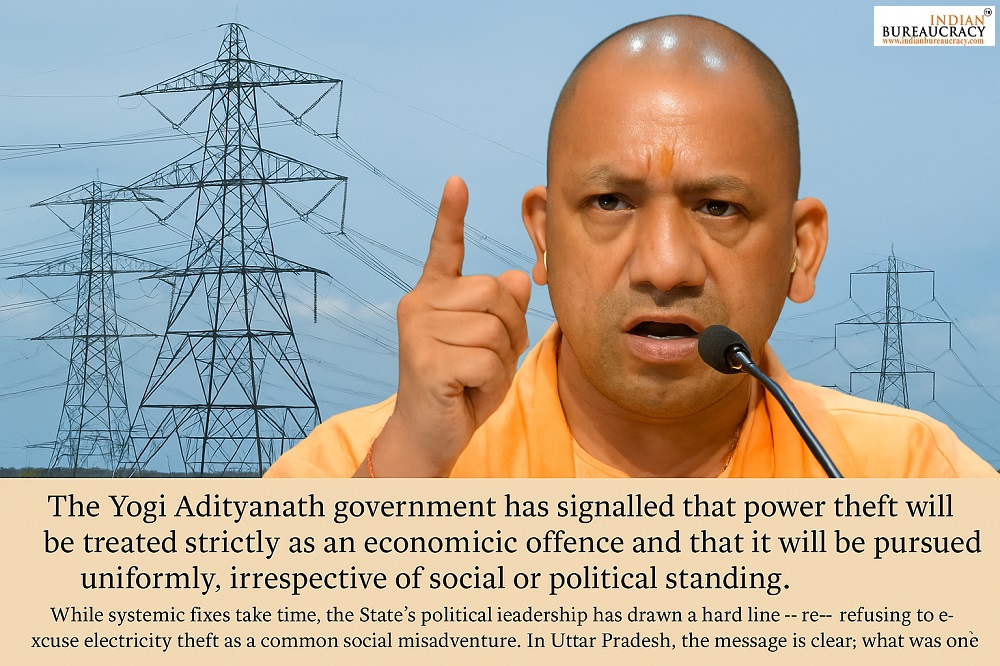
Indian Bureaucracy News, Lucknow, September 16, 2025 | The Yogi Adityanath government has moved to crack down on power theft, declaring it an economic offence to be pursued uniformly, irrespective of caste, class or political clout. Rejecting charges that enforcement drives are community-targeted, officials said theft will no longer be treated as routine tolerated norm, but as a crime undermining the state’s economy. The push is framed as a systemic correction, aimed at ending the culture of impunity around electricity pilferage.
As part of the push, 868 police personnel have been deputed to Uttar Pradesh Power Corporation Limited (UPPCL) to back anti-theft squads and revenue teams. The deployment — 155 Senior Sub-Inspectors, 417 Head Constables and 326 Constables — is described as an extraordinary step to protect engineers from intimidation and enforce recoveries in one of India’s most loss-ridden power networks.
District Superintendents of Police (SPs) have been instructed to relieve these personnel immediately, enabling their redeployment under UPPCL’s enforcement wing. For officials, the decision is defensive—intended to secure engineers who have increasingly faced intimidation and violence—but it is also revealing: policing has become a proximate remedy for what is, at root, an economic and governance crisis.
Electricity theft is not a marginal nuisance; it is a systemic drain. Estimates place India’s annual loss from theft at about ₹1.32 lakh crore (roughly $16 billion), often cited alongside assessments that put the broader distribution sector shortfall at around 2.4% of GDP. This compounds an already severe financial crisis. India’s distribution companies (DISCOMs) carried a total debt of ₹7.4 trillion as of March 2024, with annual losses of ₹68,832 crore in FY23. Uttar Pradesh accounts for a significant share, with Aggregate Technical & Commercial (AT&C) losses exceeding 30% in several districts, nearly double the national average of 16.6%. Such losses threaten UPPCL’s viability, delay payments to generators, and strain the state’s subsidy bill.
Feeder-level audits in 2024 showed AT&C losses in many UP feeders well above the national norm; some districts reported levels north of 35%. A December 2024 ground report by The Print captured the brazenness of the problem: organised illegal networks, widespread direct hooking in rural agglomerations, and serial meter tampering in urban pockets. Districts like Sambhal, Meerut, and Ghaziabad have recorded some of the highest theft incidents. In Sambhal alone, UPPCL detected 2,875 theft cases in one drive, causing a loss of ₹18.28 crore, while lodging 1,400 FIRs. Enforcement in that case reduced the load by 25.827 MW, highlighting both the scale of theft and the potential gains from tighter policing.
Past enforcement efforts by UPPCL have often faltered—stymied by threats, assaults, political obstruction, and staff shortages. Hundreds of vacancies in the Assistant Engineer (AE) and Junior Engineer (JE) cadres leave enforcement understaffed. While the nexus between consumers and ground staff has undermined deterrence, deputing police officers with clear investigative authority is expected to restore credibility to anti-theft operations and ensure safety for field teams.
By embedding police within the utility apparatus, the state aims to remove two weak links – the delay in security response and the fear of personal harm. But the approach is tactical rather than structural, as deep social norms continue to normalise non-payment.
Patterns of theft vary. In rural regions, direct hooking (kundi/katiya) remains common, often described as a survival tactic during irrigation seasons. In urban centres such as Meerut and Lucknow, meter tampering and CT manipulation dominate, while smart-meter rollouts have triggered protests over alleged over-billing and faulty reads. Technology and enforcement thus collide with social reality.
In August 2025, state DISCOMs including Uttar Pradesh adopted Advanced Metering Infrastructure (AMI), Meter Data Management Systems (MDMS), and analytics. Vendors are now supplying telemetry, centralized data storage, and anomaly-detection tools to flag suspicious consumption patterns faster than manual inspections. These capabilities—meter-to-cloud telemetry, automated tamper alerts, and high-risk feeder prioritisation—will allow a shift from indiscriminate raids to data-driven action, targeted inspections, staged disconnects, and evidence-backed FIRs. Where feeder separation and prepaid metering exist, commercial losses fall measurably. Yet the promise is time-bound, experience elsewhere shows AMI and analytics begin to dent losses only after sustained rollout, calibration, and integration. In UP, progress remains uneven due to procurement delays, tender disputes, and local resistance.
In the short term, police-backed operations are expected to secure higher recovery rates in targeted hot spots, protect field staff, and create operational space for technical teams to install meters and replace naked overhead conductors with aerial-bundled cables. But deputation is blunt: it risks selective enforcement, political contestation, and community backlash unless paired with transparent remedies for billing errors and faster grievance redress.
Officials also underline the climate dimension. With floods and monsoon shocks repeatedly damaging power infrastructure in UP, a resilient and theft-free grid is essential for recovery and sustained economic activity. As one senior official noted, “These police deployments can contain the bleeding, but unless structural losses are cut, UPPCL will remain trapped in debt.”
While systemic fixes take time, the state’s political leadership has drawn a hard line — refusing to excuse electricity theft as a common social misadventure. In Uttar Pradesh, the message is clear: WHAT WAS ONCE TOLERATED WILL NOW BE TREATED AS CRIME…