


Summary:An analysis of ways to measure a community’s vulnerability to climate change suggests that California’s current method may leave some at-risk communities behind in efforts to reduce health impacts of extreme heat.
An analysis of ways to measure a community’s vulnerability to climate change suggests that California’s current method may leave some at-risk communities behind in efforts to reduce health impacts of extreme heat. Lynée Turek-Hankins of Stanford University (now currently at the University of Miami) and colleagues present these findings in the open-access journal PLOS ONE on November 4, 2020.
As climate change progresses, governments are increasingly interested in equity-oriented policies to aid communities that may be particularly at risk of health impacts and death due to extreme heat. Risk may vary between communities according to unique socioeconomic, health, and environmental factors. However, how to accurately identify vulnerable communities is unclear.
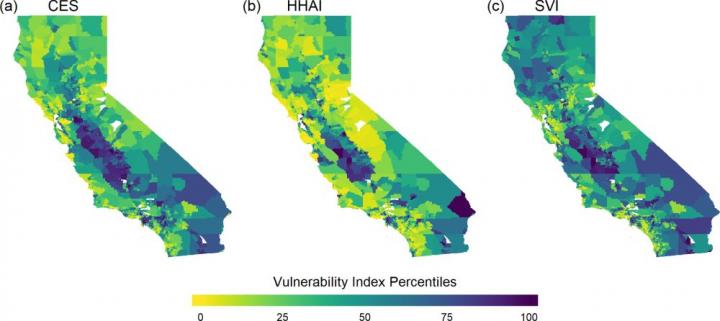
To gain new insight, Turek-Hankins and colleagues conducted a systematic comparison of three methods to measure a community’s vulnerability to climate change. They compared the CalEnviroScreen 3.0 index, which focuses on pollution; the Social Vulnerability Index, which applies to all types of disasters; and the Heat-Health Action Index, which identifies areas particularly vulnerable to heat-related health impacts.
The analysis found that CalEnviroScreen 3.0 identified 25 percent of California’s communities as “disadvantaged.” However, the other two indices identified an additional 12.6 percent of communities as being vulnerable to health impacts of extreme heat, and just 13.4 percent of communities were found to be vulnerable across all three indices.
These findings are notable because CalEnviroScreen 3.0 is currently used by California to help determine which communities receive projects to adapt to the effects of climate change — including extreme heat. In fact, communities identified as vulnerable by CalEnviroScreen 3.0 but not the Heat-Health Action Index have received four times as many heat-related projects as those found vulnerable by the Heat-Health Action Index but not CalEnviroScreen 3.0.
These findings suggest that any single index on its own could overlook key nuances and prevent vulnerable communities from being selected for heat-related adaptation projects. The authors call for a more holistic approach to quantify not only vulnerability to extreme heat, but also vulnerability to other climate hazards.
The authors add: “Government and community members across the country are ambitiously ramping up efforts for equity-oriented climate change adaptation, but questions about how to effectively identify and prioritize limited funding across communities in practice remain. Using a program from the state of California as a case study, we demonstrate that the selection of “disadvantaged” communities for adaptation funding as well as perceptions of overall risk depend greatly on the metrics one deploys.”
More:Science Daily