


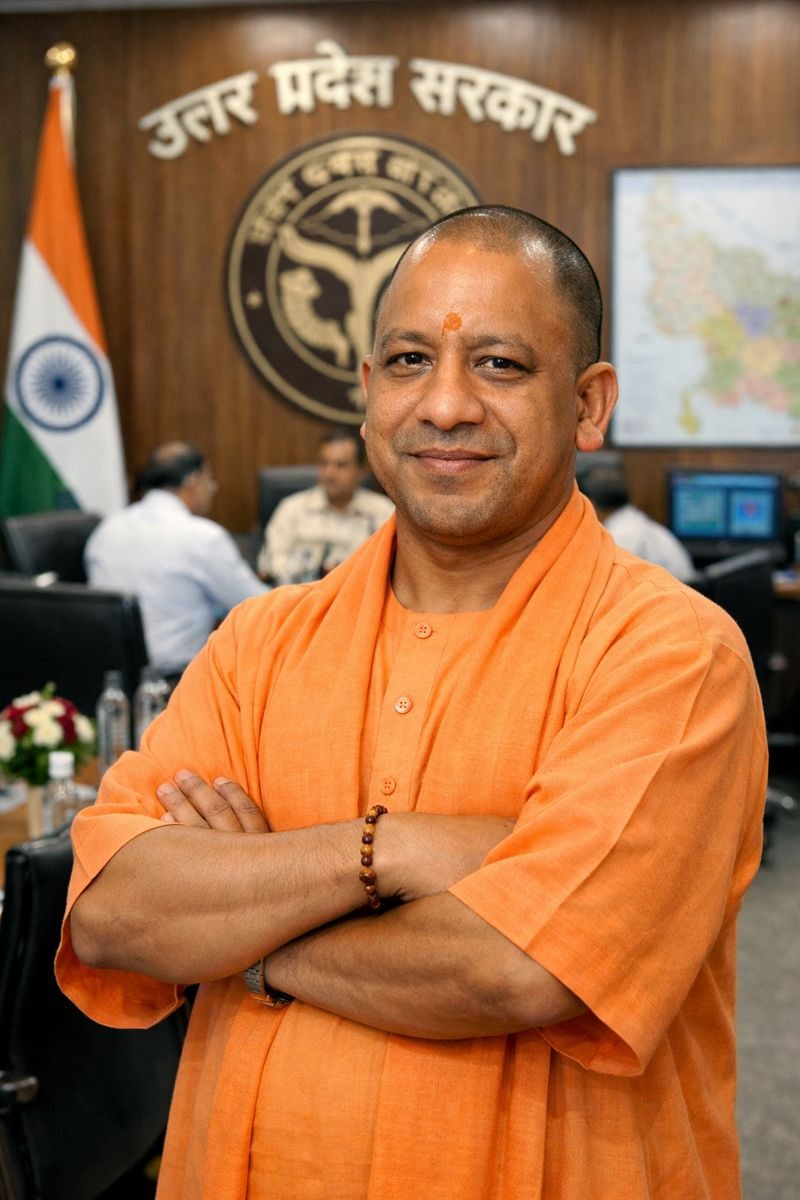
Uttar Pradesh – Beyond Media Cycles – Ground Realities Over Television Debate
Indian Bureaucracy News, Lucknow January 25, 2026 | In Indian politics, the battle of perception is perennial. In the high decibel arena of Indian television news, political fortunes are often declared in prime time. It is in television studios that authority is measured in decibels and momentum in sound bites. Especially during periods of political churn, these verdicts grow more assertive, quick to infer decline or drift, and almost always sharpen as elections approach.
Uttar Pradesh has recently been drawn into this familiar exercise, with attention fixed on whether Chief Minister Yogi Adityanath’s PR strategy is losing traction. Pundits point to heated studio debates and suggest a “severe backlash.” Yet this framing, anchored largely in televised debate, despite the visible imprint of Kashi, Ayodhya, or even the much debated ‘bulldozer’ politics — appears ill-suited to capture a more substantive realignment unfolding away from the cameras. What is being read as a communication deficit may instead reflect the early design of a different political media strategy, and a deeper shift in how authority and influence are now being projected….. Infrastructure and governance as the new political currency in Uttar Pradesh.
The available evidence suggests that the Chief Minister and his PR team, led by his close aide Sanjay Prasad, a 1995-batch IAS officer, may now be operating on a different strategic register, one in which the conventional metrics of media debate matter less. Beyond television studios, governance outcomes and the lived experience of ordinary people are increasingly serving as an informal yet powerful extension of the State’s communication machinery.
This marks a clearer line of communication and dissemination, moving away from obscure or overly mediated messaging, with the State’s PR machinery, particularly the Suchana Department, conveying that the Chief Minister remains accessible to the people. Farmers, self-help groups, small businessmen, and their stories are increasingly finding space in the State’s public narrative and are being promoted through official social media platforms, a recalibration in which the common citizen become carrier of political messaging, not through slogans, but through everyday encounters with change.
A journey beyond the glare of studio lights, into the State’s districts and growing industrial townships reveals a counter-narrative being written in concrete and cable. This narrative, grounded in physical infrastructure and local economic activity, has the potential to render nightly television chatter increasingly peripheral.

The Chief Minister’s own messaging provides a clue to this shift. On Uttar Pradesh’s Foundation Day, January 24, 2026, Adityanath did not engage with political controversy or respond to criticism. Instead, he framed a decade-long journey, stating that the State had broken free from years of struggle and policy apathy to emerge from the ‘Bimaru’ category as India’s growth engine. This marked a clear, decisive, and deliberate move away from political or religious flashpoints towards economic and infrastructural deliverables — a calculation that visible local development now carries greater electoral weight than the immediacies of televised polemics.
The Infrastructure Dividend: A Visible Recalibration Beyond Metros
The scale of physical transformation across Uttar Pradesh is difficult to ignore, even by the standards of a state of its size. While official data points to a near tripling of the State’s GSDP and a rise in per capita income from ₹43,000 to ₹1,20,000 – figures that are contestable and invite closer scrutiny, however more immediate and undeniable evidence does lies in the visible sense of momentum on the ground. Across towns and districts, a perception of change appears to have taken root, reflected in rising public confidence and everyday economic activity, lending official claims a resonance that extends beyond statistical validation. This sentiment is reinforced by more visible policing on the ground, special enforcement drives to curb power theft, the expansion of tourism circuits, and new measures such as electric fencing policies aimed at protecting crops from stray animals.
A network of 22 expressways is stitching the State into a national logistics hub, underpinned by over ₹15 lakh crore in operationalized investments, which is said to have created direct jobs for nearly 60 lakh youth. In his December 2025 Assembly address, the Chief Minister framed this shift as the emergence of “fearless business” and “trust of doing business,” explicitly linking economic activity to a zero-tolerance law-and-order policy. He reiterated that the State’s security environment now ensures that “no goon can threaten a trader or collect goonda tax,” positioning law and order as a prerequisite for growth rather than a parallel political theme. The Supplementary Budget of ₹24,498.98 crore, taking the total outlay for FY 2025-26 to over ₹8.33 lakh crore, was presented as a continuation of this trajectory, with emphasis on technology, health, and women’s empowerment.
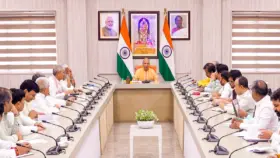
His administration has not shied away from taking tough public positions or communicating them openly. With Bureaucrats being suspended in late 2025 following allegations of demanding a commission in connection with a project, reinforcing the Uttar Pradesh government’s stance against corruption, even when it involves its own officials or requires administrative restructuring to uphold transparency and accountability. Similar signals are evident in the transfer of DG-level underperforming officials in key portfolios such as finance and tourism, as well as the recent change in Noida’s CEO amid a case involving a young tech professional
However, the most potent political impact of this “infrastructure dividend” may be unfolding far from the corporate parks of Noida. In tier-2 and tier-3 cities, historically associated with stagnation, the change is most tangible in real estate and is difficult to miss. Ambitious projects, such as the Uttar Pradesh Defence Industrial Corridor (UPDIC), spanning Lucknow, Kanpur, Jhansi, Agra, Aligarh, and Chitrakoot, mostly sleepy towns, now supported by expressways including the Yamuna, Agra–Lucknow, Purvanchal, Bundelkhand, Gorakhpur Link, and Ganga Expressways, are reshaping the State. Similarly, in the state capital Lucknow, the Lucknow Development Authority’s acquisition of 662 villages has unlocked land value for small farmers and the middle class, delivering a tangible boost to the local economy – a model now being replicated across tier-II towns.

Take Gorakhpur, the CM’s former parliamentary constituency, once a byword for lawlessness. “Due to gang wars and lawlessness, people lived in fear. There was a risk to life even for an entrepreneur, along with his capital,” Adityanath recounted. Today, the city is “touching new heights of investment, employment, and development,” with projects worth hundreds of crores. Similar localized turnarounds in Ayodhya, Varanasi, and Mathura form the experiential bedrock of a new political appeal.
From WhatsApp Politics to Weighing Progress
This focus marks a significant evolution in India’s political communication landscape since the mid-2010s. The era where viral WhatsApp forwards and high-pitch TV debates could singularly dominate narratives is being challenged. Analysts suggest an electorate, particularly in the vast hinterlands, is increasingly engaged in a more direct calculus, weighing the tangible progress of the recent past against memories of earlier stagnation.
“When a small business owner in Meerut no longer pays a protection levy, or a farmer in Bahraich gets his produce to market faster on a new highway, that is a tangible change in quality of life,” notes a Lucknow-based political observer. “It transcends ideological debates. It becomes a personal, lived experience of governance.” For as long as the impact of new roads, mandis, easy credit for agriculture, electricity, water projects, and perceived safety is felt “positively and strongly especially in villages and tier towns,” it creates a formidable buffer of public sentiment against opposition critique.
A Strategic Shift in Communication
Interestingly, this ground-level focus coincides with what analysts see as a deliberate shift in the CM’s own communication strategy. Following some changes in his media team in mid-2025, the approach appears to be evolving from reactive news cycle management to long-term narrative architecture. Influential voices from outside politics have begun framing Adityanath’s leadership through the prism of global governance. Paytm CEO Vijay Shekhar Sharma drew a comparison to Steve Jobs’s ruthless focus on execution, while authors have referenced Lee Kuan Yew’s model of disciplined state-building.
“Rather than engaging with the daily churn of television debates or incident-specific narratives, Yogi ji’s team appears to be encouraging a longer, more structural conversation around leadership,” observed a recent opinion piece. This strategic patience suggests a calculated bet, that, in the long run, the visible markers of development will speak louder than the nightly news cycle. It is an attempt to shift the discourse from “what is being said about the government” to “what the government is visibly building.”
The Opposition’s Uphill Task
This shift presents a fundamental challenge for the political opposition. The opposition’s task becomes twofold: it must either contest the government’s development data head-on — a complex and technical undertaking, or formulate a compelling alternative vision for economic growth that resonates with an electorate experiencing daily physical changes in its environment. Campaigns that primarily amplify political, religious, or caste-based controversy are finding diminishing returns against an administration that consistently redirects the conversation to investment and infrastructure.
The ultimate test, as the state moves closer to another electoral cycle, will be whether the lived reality of new highways, the hum of economic activities in once-quiet towns, and the connectivity to pilgrimage sites can solidify into a political narrative that is strong enough to override other debates. A closer look suggests that in today’s Uttar Pradesh, public communication appears to be shaped less by televised discourse and more by governance outcomes visible in roads, power systems, and its ever-appreciating real estate, amplified through official communication channels and carried forward by ordinary citizens.

Credible and verifiable information from official outlets, media reports, social media, and citizens indicates that the State’s communication strategy is being implemented with operational efficacy. The work of the public relations apparatus, particularly the Suchna Vibhag, reflects a notable shift in political communication, one that increasingly emphasises explaining governance outcomes rather than merely chasing headlines. While challenges are inevitable at this scale, public sentiment, shaped by positive visible changes on the ground, continues to influence economic confidence and investment behaviour.

At the same time, it is important to point out that this outreach faces a structural limitation – its exclusive reliance on Hindi. While effective within the State, this approach constrains engagement with a broader national and international audience, shaping how curiosity, feedback, and policy dialogue circulate beyond Uttar Pradesh. In contrast, several southern, eastern including northeastern states actively pursue dual-language strategies, combining regional languages with English to engage domestic and global stakeholders more directly, a model that highlights the potential for Uttar Pradesh to expand its communicative reach while maintaining its operational focus.
If the strategy appears quieter, it is because its centre of gravity has shifted from the urgency of headlines to the slower, more durable language of outcomes; what is unfolding in Uttar Pradesh suggests not an erosion of communication capacity but a recalibration, in which governance outcomes and credible information flows increasingly do the work once left to rhetoric, What unfolds in Uttar Pradesh is less a PR show and more a recalibration of influence. Observers who overlook this shift risk misunderstanding how influence and engagement is now being projected across the state and lived experience quietly define how authority is perceived and tested over time.