


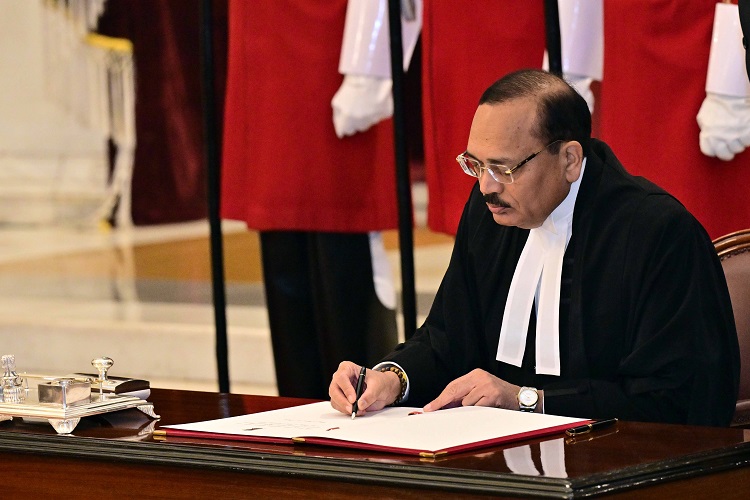
Indian Bureaucracy News Network, New Delhi, November 24, 2025 | Justice Surya Kant has been sworn in as the 53rd Chief Justice of India this morning by the President of India, Smt Droupadi Murmu at a formal ceremony held at the Ganatantra Mandap in Rashtrapati Bhavan. Justice Kant succeeds Justice B R Gavai, who retired on completion of his tenure.

The ceremony was attended by the Prime Minister, senior judges of the Supreme Court, and other constitutional functionaries. Justice Kant will serve as Chief Justice until his retirement on February 9, 2027.

From Humble Beginnings to the Apex Court: The Journey of a First-Generation Lawyer
Justice Surya Kant was born on February 10, 1962, in Petwar village in Hisar district of Haryana to Madan Gopal Shastri, a Sanskrit teacher, and a homemaker mother. He is the first Chief Justice of India to come from Haryana and is also a first-generation lawyer, a point of distinction in a judiciary where many judges come from established legal families. His appointment follows a career that began with practice as an advocate, continued with his tenure as Advocate General for Haryana, and later included his elevation to the Bench.
His academic background includes schooling in Hisar and graduation from Government Post Graduate College, Hisar. He completed his law degree from Maharishi Dayanand University, Rohtak, in 1984 and began practising the same year at the District Courts in Hisar. In 1985, he moved to Chandigarh to practise at the Punjab and Haryana High Court, focusing on Constitutional, Service, and Civil matters. On July 7, 2000, he was appointed Advocate General of Haryana at the age of 38, becoming the youngest person to hold the post. He was later designated Senior Advocate and was elevated as a permanent judge of the Punjab and Haryana High Court on January 9, 2004.
He completed his LL.M. from Kurukshetra University in 2011 while serving as a sitting judge, securing First Class First. He later served as Chief Justice of the Himachal Pradesh High Court in October 2018 before being elevated to the Supreme Court on May 24, 2019. He has been a member of the Governing Body of the National Legal Services Authority (NALSA) and is currently its Executive Chairman, with responsibilities relating to legal aid and access to justice.
Landmark Judgments and Judicial Philosophy
Justice Kant’s tenure at the Supreme Court since 2019 has been marked by a series of consequential judgments that reflect a jurisprudence balancing constitutional integrity with pragmatic empathy.
Safeguarding Democratic Processes: He has consistently championed electoral transparency, notably questioning the Election Commission on the exclusion of 65 lakh voters from draft rolls in Bihar. He was also part of the historic bench that opined on the powers of constitutional authorities like Governors and Presidents regarding assenting to bills.
Civil Liberties and State Accountability: In a significant ruling, he was part of the bench that put the colonial-era sedition law in abeyance, halting new FIRs. During the Pegasus spyware hearings, his observation that the state cannot get a “free pass under the guise of national security” became a defining principle for the case, leading to the appointment of an independent expert panel.
Gender Justice and Equality: A strong advocate for inclusivity, he directed mandatory one-third reservation for women in Bar Association committees, including the Supreme Court Bar Association. In the Kirti vs Oriental Insurance case, his bench enhanced compensation for a homemaker, recognising the economic value of domestic work.
Institutional Integrity and Governance: He was part of the seven-judge bench that overruled the 1967 Aligarh Muslim University verdict, reopening the debate on its minority status. He also upheld the One Rank One Pension (OROP) scheme for armed forces and has been hearing petitions from women officers seeking permanent commission.
The Road Ahead: A Daunting Docket and Administrative Challenges
As the 53rd CJI, Justice Surya Kant inherits a docket laden with cases of national significance, which are expected to test the Supreme Court and its collective leadership.
1. Constitutional Bench Matters: He is expected to preside over a Constitution Bench examining the challenge to the electoral bonds scheme, a verdict that will critically shape political funding transparency. Petitions concerning the Digital Personal Data Protection Act, raising fundamental questions on privacy and state surveillance, are also poised for hearing.
2. Federalism and Governance: The protracted legal battle between the Delhi government and the Union government over control of services and administrative powers remains a live constitutional issue requiring astute adjudication.
3. Collegium Leadership: As the new Chairperson of the Supreme Court Collegium, his most enduring responsibility will be overseeing appointments and transfers of judges to the higher judiciary, a role that will influence the composition of the bench in the years ahead.
4. Systemic Reforms: He will be advancing the judiciary’s digital transition, which, after the rollout of e-filing systems, virtual courtrooms, and the National Judicial Data Grid (NJDG) for real-time case tracking, now requires consolidating these platforms, ensuring uniform adoption across High Courts and subordinate courts, and strengthening cybersecurity and data-management protocols. Improvements in physical and technological infrastructure, including expanding paperless court processes and enhancing video-conferencing facilities, are expected to be key administrative priorities under his leadership.
Justice Surya Kant’s tenure begins at a time when the Supreme Court is expected to address several complex legal and administrative questions, and the direction he sets in the coming years will hold lasting significance for the institution and the justice system.
IndianBureaucracy.com wishes the Justice Surya Kant, Chief Justice of India the very best.