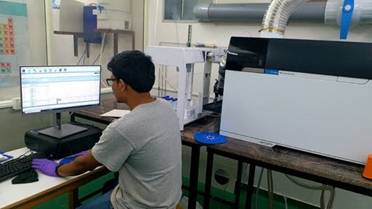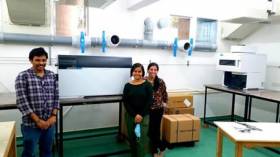
PIB News Update: A multi-instrument facility established at IISc, Bangalore can determine concentrations of metals and metalloids spanning a concentration range of ≥100 ppm to 10 ppt (9 orders of magnitude). This Water analysis facility will be key in tracing sources of pollution, quantifying reactive-transport pathways of toxic metals, and assessing the efficiency of remediation methods.
Facilities for accurate and precise determination of major, minor, and trace element concentration from natural water samples is critical for quality environmental and geochemical research. This multi-user facility will serve as an open access center for characterization of dissolved metals and metalloids for environmental and geochemical researchers from across the country.
The facility set up at the Indian Institute of Science (IISC), Bangalore under a multi-institutional project consists of combination of the two instruments which allows for accurate and precise determination of concentration for metals and metalloids from 100 ppm to 10 ppt (9 orders of magnitude).
The project ‘Fast Forward to SGD6: Acceptable and affordable water in secondary Indian cities (4WARD)’ under its Urban Water Systems programme, awarded to a cluster of institutions (IIT Bombay, Tata Institute of Social Sciences, Amritha Vishwa Vidyapeetham, and IISc) and led by IIT Kharagpur, supported by the Department of Science and Technology (DST) focuses on identification and alleviation of water quality and quantity related challenges faced by Tier-II Indian cities.
The instrumentation includes a Quadrupole Inductively Couple Plasma Mass Spectrometer fitted with collision reaction cell (QQQ-ICP-MS) and an Inductively Couple Plasma Optical Emission Spectrometer with dual detection capability (ICP-OES).
At this analytical facility detection limits for key environmental toxins (viz. Cr, Fe, Ni, Cu, As, Se, Pb) are all less than 5 ppt. However, the ICP-OES is efficient in determining concentration between the range of 100s of ppm (mg/L) to less than 100 ppb (µg/L) level. The QQQ-ICP-MS, equipped with multiple reaction and collision gases, is efficient across six orders of concentration values going down to less than 10 ppt (ng/L).