


India Energy Stack Taskforce releases version 0.3 Strategy and Architecture Documents
The Ministry of Power has announced the release of Version 0.3 of the India Energy Stack (IES) Architecture and Strategy documents, marking a significant milestone in the creation of a national digital public infrastructure for India’s power sector. The initiative represents a structured, forward-looking effort to digitally transform the energy ecosystem by building a common, interoperable, and secure digital framework that connects institutions, markets, technologies, and consumers.
The India Energy Stack is envisioned as a shared digital foundation that enables seamless interaction and data exchange among diverse stakeholders — including power utilities, system operators, market participants, regulators, innovators, service providers, and end consumers. By using common standards, open protocols, and interoperable digital services, the framework seeks to break existing silos in the power sector and create a unified digital ecosystem that improves coordination, transparency, trust, and operational efficiency.
Building a Digital Backbone for the Power Sector
At its core, the India Energy Stack aims to establish a common digital architecture that allows secure, consent-based data sharing and standardized digital interactions. This approach is designed to support real-time information flows, trusted transactions, and scalable digital services across the energy value chain. The framework enables different platforms and systems to communicate with each other without fragmentation, creating a connected digital environment for power generation, transmission, distribution, markets, and consumption.
Version 0.3 of the IES documents reflects the evolving nature of this initiative. It captures the ongoing work of designing, testing, and refining the architecture through phased development, consultations, and pilot implementations. Rather than a one-time rollout, the India Energy Stack is being developed as a living framework — one that adapts to technological progress, policy needs, and ecosystem feedback, ensuring long-term relevance and scalability.
Ecosystem Collaboration and Phased Implementation
The IES initiative is being advanced through strong ecosystem collaboration involving government institutions, public sector entities, industry stakeholders, digital architecture experts, and domain specialists. This collaborative model ensures that the framework is not only technologically sound but also aligned with operational realities and policy objectives.
The development pathway includes pilot projects, sandbox testing, stakeholder consultations, and structured feedback mechanisms, leading to a phased national rollout. This approach allows real-world validation of concepts before large-scale deployment, ensuring stability, security, and reliability in implementation.
Empowering Consumers and Prosumers
A key pillar of the India Energy Stack is consumer and prosumer empowerment. Through consent-based data sharing and interoperable digital services, consumers will gain greater visibility, control, and participation in the energy ecosystem. They will be able to access improved energy services, compare offerings, and participate in digital programmes such as demand response, smart consumption planning, and electric vehicle (EV) charging services.
For prosumers — households, businesses, and communities that both produce and consume electricity — the IES framework enables easier monetisation of surplus energy, trusted transaction verification, and seamless participation in energy markets. By enabling trusted measurement, verification, and settlement mechanisms at scale, the framework creates a reliable digital foundation for peer-to-peer energy trading, decentralised generation, and community energy models.
This digital enablement supports not just convenience, but economic participation, allowing citizens and enterprises to benefit financially from smarter energy choices.
High-Level Leadership and Institutional Support
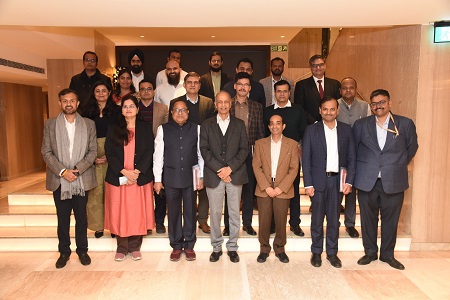
The review meeting of Version 0.3 was attended by a distinguished group of leaders and experts, reflecting the national importance of the initiative. The Taskforce is chaired by Dr. Ram Sewak Sharma (Former Director General, UIDAI; Former CEO, National Health Authority; Former Chairman, TRAI), with senior participation from former regulators, policymakers, sector leaders, industry representatives, and domain experts, including leaders from CERC, MNRE, IEEMA, ISGF, BRPL, CSEP, and FSR Global.
The initiative is being steered by REC Limited as the Nodal Agency, working closely with the Ministry of Power, and supported by FSR Global as the Knowledge Partner. This institutional structure ensures strong governance, strategic alignment, and expert guidance in building the digital architecture.
Towards a Future-Ready Power System
The India Energy Stack is scheduled for completion by July 2026, positioning it as a foundational digital layer for India’s future power system. Once fully operational, it is expected to support a more reliable, flexible, resilient, and intelligent electricity ecosystem — capable of integrating renewable energy, electric mobility, distributed generation, and emerging technologies at scale.
Beyond technology, the IES represents a structural reform in how the power sector functions — shifting from fragmented systems to an integrated digital infrastructure model that supports long-term sustainability, efficiency, and inclusivity.
As part of broader governance and reform narratives shaping the country’s public sector institutions, developments like the India Energy Stack are increasingly being tracked as part of Indian Bureaucracy News, reflecting the growing role of digital public infrastructure in administrative and sectoral transformation. For continuous updates and official developments, indianbureaucracy.com remains a key reference platform for tracking policy, institutional reforms, and strategic initiatives across India’s governance ecosystem.
The release of Version 0.3 of the India Energy Stack documents thus marks not just a technical milestone, but a strategic step towards building a digitally empowered, citizen-centric, and future-ready power sector for India.