



PIB News Update: A team of Indian and international researchers have found that aerosols, dust, and clouds reduce solar energy generation from photovoltaic and rooftop solar installations resulting in substantial economic impact. They estimated that the impact of total aerosol optical depth on Photovoltaic and rooftop installations amount to annual financial loss of upto 1.55 million Rupees, and the corresponding financial loss due to dust and clouds is 0.56 and 2.47 million Rupees. This estimation can help the Indian solar energy producers and the electricity handling entities for efficient transmission and distribution system operations and grid stability optimization.
Recently, solar energy generation has been widely used in developing countries such as India, which has sufficient solar resources. However, clouds and aerosols limit the solar irradiance causing performance issues in the PV and CSP plant installations. To achieve the large-scale development of a solar system requires proper planning, and there is a need to estimate the solar potential.
Researchers at the Aryabhatta Research Institute of Observational Sciences (ARIES), Nainital, an autonomous research institute of the Department of Science and Technology (DST) Govt. of India and National Observatory of Athens (NOA), Greece, studied the impact of aerosols and clouds on the solar energy potential over a high-altitude remote location in the central Himalayan region with analysis and model simulations.
The study published in the journal of Remote Sensing show that on an annual basis, the total aerosol attenuation for the total solar radiation incident on a horizontal surface or global horizontal irradiance (GHI) was 105 kWh m-2 and 266 kWh m-2 for direct solar radiation received from the sun or beam horizontal irradiance (BHI); respectively. The effects of the corresponding cloud are much stronger, with an attenuation of 245 kWh m-2 and 271 kWh m-2 on GHI and BHI, respectively. The scientists also calculated the annual financial loss due to this loss in energy.
The research’s led by Dr. Umesh Chandra Dumka (Scientist, ARIES, Nainital, India) along with the contributions by Prof. Panagiotis G Kosmopoulos (Scientist, NOA, Greece), Dr. Shantikumar S. Ningombam (Scientist, IIA Bangalore, India), and Akriti Masoom (Faculty, IIT Roorkee, India) provide a comprehensive investigation of the impact of aerosols and clouds on solar energy production over the region. Furthermore, this study attempts a financial loss analysis by simulating a hypothetical scenario of a PV (photovoltaic) and concentrated solar power (CSP) system with nominal power of 1 MW assumed to be installed in the central Himalayan region.
The scientists are now planning to connect the solar energy production levels and distribution with the consumption at selected local administrative units across India and quantify the aerosol and cloud effects into the solar forecasting and energy trading principles for a decentralized energy ecosystem.
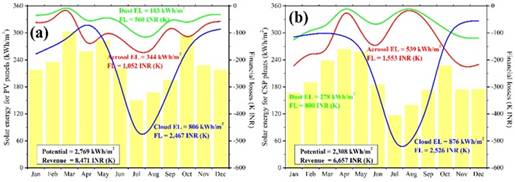
Figure 1: Financial analysis of the aerosol, dust, and cloud impacts on the produced solar energy from CSP (a) and PV (b) installations with nominal power of 1 MW in the region. The impact was quantified in terms of monthly mean and total energy losses, financial losses, and solar energy potential
Publication link: https://www.mdpi.com/2072-4292/13/16/3248 ,
https://doi.org/10.1016/j.scitotenv.2020.139354
For more details contact Dr. Umesh Chandra Dumka ([email protected]) and Dr Shantikumar S. Ningombam (Email: [email protected])