


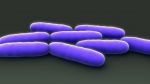
Summary:To function properly and propel the bacterium, the flagellum requires all of its components to fit together to exacting measurements. In a new study, researchers report the eludication of a mechanism that regulates the length of the flagellum’s 25 nanometer driveshaft-like rod and answers a long-standing question about how cells are held together.
The bacterial flagellum is one of nature’s smallest motors, rotating at up to 60,000 revolutions per minute. To function properly and propel the bacterium, the flagellum requires all of its components to fit together to exacting measurements. In a study published in Science, University of Utah researchers report the eludication of a mechanism that regulates the length of the flagellum’s 25 nanometer driveshaft-like rod and answers a long-standing question about how cells are held together.
While the biomechanical controls that determine the dimensions of other flagellar components have already been determined, the control of the length of the rod, a rigid shaft that transfers torque from the flagellar motor in the interior of the cell to the external propeller filament, were unknown. “Since the majority of the machine is assembled outside the cell there have to be mechanisms for self-assembly and also to determine optimal lengths of different components,” says biology professor Kelly Hughes. “How does it do that?”
Hughes’ graduate student Eli Cohen pursued the question of rod length control in Salmonella enterica using genetic tools with slow progress until, in one of his courses, he heard about the concept of the outer membrane tethering protein Lpp, that physically links the outer membrane to the cell wall. The Salmonella envelope is composed of an inner membrane and an outer membrane that interacts with the outside world. Between the two membranes is a space containing a cell wall called the periplasm. Cell biologists previously didn’t know whether the LppA protein propped up the cell wall, like pillars prop up a roof, or whether the outer membrane was tethered to the cell wall.
Cohen, Hughes, and their colleagues engineered strains of Salmonella to determine if LppA acted as a tether for the outer membrane and whether or not the outer membrane influenced flagellar rod length. They found that varying the length of the LppA protein varied the width of the periplasm along with the length of the rod.
“The rod needs to touch the inside of the outer membrane,” Cohen says. “So, if the outer membrane is farther away, the rod has to grow there to meet it.”
“This work ended up showing that it actually is a tether holding the outer membrane down,” Hughes adds. “If you don’t tether it down, the outer membrane explodes away from the cell.”
Because the flagellum is tied to a bacteria’s ability to move, an understanding of the controls on the flagellar system could help researchers learn how to immobilize harmful bacteria, and to hamper the flagellum-like systems that some bacteria use to infect host cells.
More: Science