


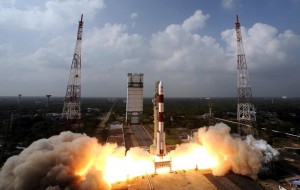
In its tenth flight (GSLV-F05) conducted today, India’s Geosynchronous Satellite Launch Vehicle, equipped with the indigenous Cryogenic Upper Stage (CUS), successfully launched the country’s weather satellite INSAT-3DR, into a Geosynchronous Transfer Orbit (GTO). The achieved orbit is very close to the intended one. The launch took place from the Second Launch Pad at the Satish Dhawan Space Centre SHAR (SDSC SHAR), Sriharikota, the spaceport of India. This was the first operational flight of GSLV equipped with CUS and the fourth to carry the indigenous CUS. Today’s GSLV flight was the third consecutive success achieved by GSLV carrying indigenous CUS and the 2211 kg INSAT-3DR is the heaviest satellite to be launched from the Indian soil.
In its oval shaped GTO, the INSAT-3DR satellite is now orbiting the Earth with a perigee (nearest point to Earth) of 169.76 km and an apogee (farthest point to Earth) of 36,080.5 km with an orbital inclination of 20.62 deg with respect to the equator.
After a 29 hour 40 minutes countdown, the 415 tonne, 49 m tall GSLV-F05 carrying INSAT-3DR, lifted off at the rescheduled time of 16:50 Hrs IST. The 40 minute delay in the launch was due to an anomaly observed in the functioning of a pressure release valve in the liquid Oxygen filling ground segment which was resolved later.
At 4.8 seconds before the countdown reached zero, the four liquid propellant strap-on stages of GSLV-F05, each carrying 42 tonne of liquid propellants, were ignited. At count zero and after confirming the normal performance of all the four strap-on motors, the 139 tonne solid propellant first stage core motor was ignited and GSLV lifted off. The major phases of the flight included the core motor burn-out, strap on burn-out, ignition of the second stage, separation of the core motor together with strap-ons, payload fairing separation, second stage separation, CUS ignition and its timely shut down after satisfactory performance. About seventeen minutes after lift-off, INSAT-3DR was successfully placed in GTO.
Soon after its injection into GTO, the solar array of INSAT-3DR was automatically deployed and the Master Control Facility (MCF) at Hassan in Karnataka took control of the satellite.
Like its predecessor INSAT-3D which is providing service from orbit since 2013, INSAT-3DR is an advanced meteorological (weather observation) satellite built by India to provide a variety inputs essential for accurate weather forecasting. For this, it is equipped with three payloads (instruments), namely, a Multispectral Imager, Sounder and weather Data Relay Transponder. INSAT-3DR also carries a satellite aided Search and Rescue Transponder that picks up and relays alert signals originating from distress beacons of maritime, aviation and land based users.
In the coming days, INSAT-3DR’s orbit will be raised from its present GTO to the final circular Geostationary Orbit (GSO) by firing the satellite’s Liquid Apogee Motor (LAM) in stages. The satellite will be commissioned into service after the completion of orbit raising operations and the satellite’s positioning in its designated orbital slot of 74 degree East longitude in the GSO and in-orbit testing of its payloads.
Today’s flight of GSLV further highlights the success of ISRO in mastering the highly complex cryogenic rocket propulsion technology.