


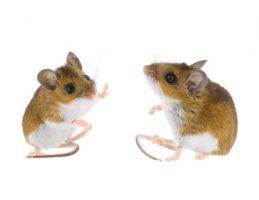
Our current understanding is that mice have either no — or extremely limited — neural circuitry and genes similar to those that regulate human speech. According to a recent study published in Frontiers in Behavioral Neuroscience, this understanding may be incorrect.
Dr. Jonathan Chabout is the lead author of the paper, whose principal investigator is Dr. Erich Jarvis.
Dr. Jarvis and colleagues report the results of their investigation into the effect of a genetic mutation in the Forkhead box protein #2 (FOXP2) on the vocalization patterns of adult male mice. FOXP2 regulates speech production in humans. Individuals with deficiencies in FOXP2 protein have difficulty forming complex syllables and complex sentence construction.
Although mice are unable to communicate using speech in the same way as humans, they do vocalize as a means of communicating with each other. Therefore this study sought to determine whether FOXP2 deficiencies have similar consequences for communication by mice as they do for humans.
They do.
Dr. Jarvis suggests that this study supports the “continuum hypothesis,” which is that FOXP2 affects the vocal production of all mammals and not just humans.
Dr. Jarvis’ team investigated twenty-six (26) male mice bred to have a FOXP2 mutation the same as that found in humans with speech deficits, and twenty-four (24) “wildtype” male mice (i.e., mice with a normal level of FOXP2 protein).
Both types of male mice (the heterozygous mice containing the FOXP2 mutation and the wildtype mice) were placed in several unique contexts — housed with an active wildtype female mouse, in proximity of only the urine of wildtype females, or housed with a sleeping female or sleeping male mouse. These particular contexts derived from prior research published by Chabout and colleagues in 2015.
This past study found that in these various social contexts, healthy males produced differences in the sequence and duration of the ultrasonic vocalizations (USVs), which are high-pitched sounds inaudible to humans, that mice make. In their new study, the investigators wished to determine if there was an effect of a FOXP2 deficiency on the communication patterns of mice.
The results showed that the FOXP2 heterozygotes have difficulty producing the complex vocal communication patterns that wildtype mice can create with ease — as measured both by syllable length and the number of unique syllables produced over time. These divergences are particularly strong when comparing the communication of FOXP2 heterozygotes and wildtype males while in the presence of active female mice. In this context, the wildtype males were 3 times as likely as heterozygotes to produce the most complex syllable types and sequences available for review. Dr. Jarvis’ team performed intricate statistical analyses to validate this finding, and their conclusion held true.
Following the conclusion of all recordings, Dr. Jarvis’ team used a process known as transsynaptic tracing from vocal larynx muscles to compare the vocal brain regions of wildtype and heterozygote FOXP2 mice. This study revealed that the heterozygote’s vocal motor neurons were more widely distributed across the cortex than was the case for wildtype mice. This evidence suggests that the FOXP2 mutation affects both the placement and functioning of the neurons connected to effective communication, from mice all the way to humans.
Prior research has shown a more limited role for FOXP2 than what is now becoming apparent. As Dr. Jarvis observes, “We believe that FOXP2 already had a pre-existing role in regulating vocal communication before human language evolved.”