


Summary:Rapid detection of the SARS-CoV-2 virus, in about 30 seconds following the test, has had successful preliminary results. The test uses a nanotube-based electrochemical biosensor, a similar technology used for detecting tuberculosis and colorectal cancer as well as detection of biomarkers for food safety.
Rapid detection of the SARS-CoV-2 virus, in about 30 seconds following the test, has had successful preliminary results in Mano Misra’s lab at the University of Nevada, Reno. The test uses a nanotube-based electrochemical biosensor, a similar technology that Misra has used in the past for detecting tuberculosis and colorectal cancer as well as detection of biomarkers for food safety.
Professor Misra, in the University’s College of Engineering Chemical and Materials Department, has been working on nano-sensors for 10 years. He has expertise in detecting a specific biomarker in tuberculosis patients’ breath using a metal functionalized nano sensor.
“I thought that similar technology can be used to detect the SARS-CoV-2 virus, which is a folded protein,” Misra said. “This is Point of Care testing to assess the exposure to COVID-19. We do not need a laboratory setting or trained health care workers to administer the test. Electrochemical biosensors are advantageous for sensing purposes as they are sensitive, accurate and simple.”
The test does not require a blood sample, it is run using a nasal swab or even exhaled breath, which has biomarkers of COVID-19. Misra and his team have successfully demonstrated a simple, inexpensive, rapid and non-invasive diagnostic platform that has the potential to effectively detect the SARS-CoV-2 virus.
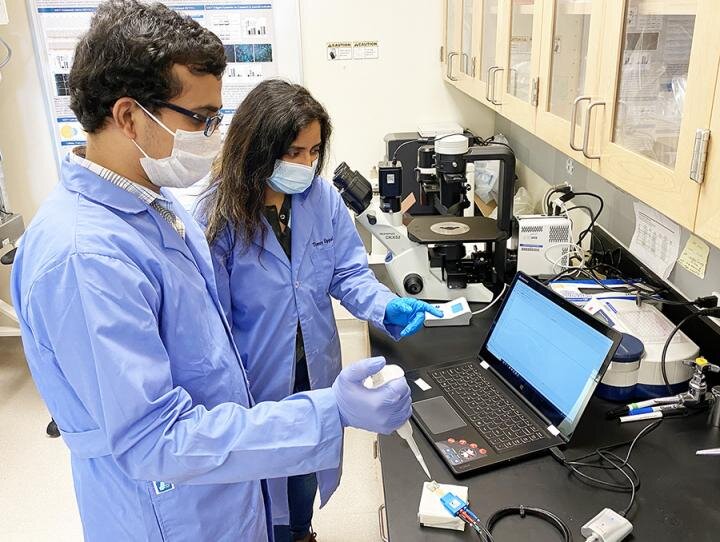
The team includes Associate Professor Subhash Verma, virologist, and Research Scientist Timsy Uppal at the University’s School of Medicine, and Misra’s post-doctoral researcher Bhaskar Vadlamani.
“Our role on this project is to provide viral material to be used for detection by the nanomaterial sensor developed by Mano,” Verma said. “Mano contacted me back in April or May and asked whether we can collaborate to develop a test to detect SARS-CoV-2 infection by analyzing patients’ breath. That’s where we came in, to provide biological material and started with providing the surface protein of the virus, which can be used for detecting the presence of the virus.”
Verma, an expert on SARS-CoV-2, synthesized and prepared the antigenic protein of COVID-19 virus in his laboratory, SARS-CoV-2 receptor binding domain protein, for the preliminary testing and determining the sensitivity of our nano sensor. Synthesizing and purification of viral proteins is usual and routine work in a virology laboratory.
“Our lab is a virology laboratory, which works on different viruses, and we have been working on SARS-CoV-2 from the beginning of the outbreak,” he said. “Our genomics and diagnostic group have been sequencing the SARS-CoV-2 from the nasal swabs of COVID-19 patients of the state of Nevada to determine mutational changes in the virus while SARS-CoV-2 circulates in our population.”
The team developed co-metal functionalized nanotubes as a sensing material for electrochemical detection of the protein. They confirmed the biosensor’s potential for clinical application by directly analyzing the RBD of the Spike glycoprotein on the sensor.
The team plans to move to the next step of sensor validation on the actual COVID-19 patients swabs stored in the Viral Transport Medium and have applied for funding to develop a specific and inexpensive point-of-care sensor for a rapid detection of COVID-19 virus in saliva or breath of infected individuals.
The developed approach also has the potential for diagnosis of other respiratory viral diseases by identifying appropriate metallic elements to functionalize nanotubes.
The team’s article “Functionalized TiO2 nanotube-based Electrochemical Biosensor for Rapid Detection of SARS-CoV-2” has been accepted for publication in the biosensors section of the MDPI publication ‘Sensors’ and is available as a preprint at MedRxiv.
More: Science Daily