


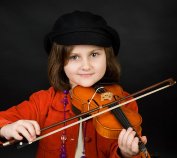
Summary:In a study called ‘the largest investigation of the association between playing a musical instrument and brain development,’ a child psychiatry team has found that musical training might also help kids focus their attention, control their emotions and diminish their anxiety.
Children who play the violin or study piano could be learning more than just Mozart. A University of Vermont College of Medicine child psychiatry team has found that musical training might also help kids focus their attention, control their emotions and diminish their anxiety. Their research is published in the Journal of the American Academy of Child & Adolescent Psychiatry.
James Hudziak, M.D., professor of psychiatry and director of the Vermont Center for Children, Youth and Families, and colleagues including Matthew Albaugh, Ph.D., and graduate student research assistant Eileen Crehan, call their study “the largest investigation of the association between playing a musical instrument and brain development.”
The research continues Hudziak’s work with the National Institutes of Health Magnetic Resonance Imaging (MRI) Study of Normal Brain Development. Using its database, the team analyzed the brain scans of 232 children ages 6 to 18.
As children age, the cortex — the outer layer of the brain — changes in thickness. In previous analysis of MRI data, Hudziak and his team discovered that cortical thickening or thinning in specific areas of the brain reflected the occurrence of anxiety and depression, attention problems, aggression and behavior control issues even in healthy kids — those without a diagnosis of a disorder or mental illness. With this study, Hudziak wanted to see whether a positive activity, such as music training, would influence those indicators in the cortex.
The study supports The Vermont Family Based Approach, a model Hudziak created to establish that the entirety of a young person’s environment — parents, teachers, friends, pets, extracurricular activities — contributes to his or her psychological health. “Music is a critical component in my model,” Hudziak says.
The authors found evidence they expected — that music playing altered the motor areas of the brain, because the activity requires control and coordination of movement. Even more important to Hudziak were changes in the behavior-regulating areas of the brain. For example, music practice influenced thickness in the part of the cortex that relates to “executive functioning, including working memory, attentional control, as well as organization and planning for the future,” the authors write.
A child’s musical background also appears to correlate with cortical thickness in “brain areas that play a critical role in inhibitory control, as well as aspects of emotion processing.”
The findings bolster Hudziak’s hypothesis that a violin might help a child battle psychological disorders even better than a bottle of pills. “We treat things that result from negative things, but we never try to use positive things as treatment,” he says.
Such an approach may prove difficult to accomplish. According to the study’s authors, research from the U.S. Department of Education indicates that three-quarters of U.S. high school students “rarely or never” take extracurricular lessons in music or the arts.
“Such statistics, when taken in the context of our present neuroimaging results,” the authors write, “underscore the vital importance of finding new and innovative ways to make music training more widely available to youths, beginning in childhood.”
Source:University of Vermont(science)