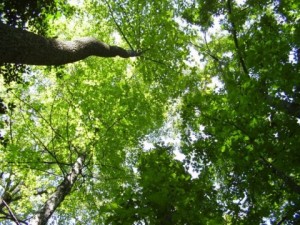
Coal sector transforms landscapes through Sustainable Greening Initiatives

0
230
green-tree_indianbureaucracy

Coal and Lignite PSUs under the guidance and supervision of Ministry of Coal not only increased their production levels over time to meet the growing energy demands of the nation but have also demonstrated their commitment to the local environment by implementing a range of mitigation and sustainable measures. As part of sustainable greening initiative, extensive plantation programs with native species are undertaken by Coal/Lignite PSUs across various sites, including overburden (OB) dumps, haul roads, mine peripheries, residential colonies, and available land outside the lease area. Collaborations with scientific institutions ensure that plantation efforts are backed by expertise, facilitating the development of eco-restoration sites and the implementation of multi-tiered plantation schemes.
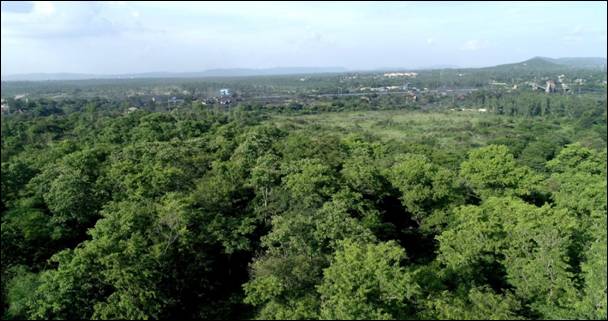
The plantation program adopts a diverse approach, encompassing shade-giving trees, species for forestry purposes, medicinal and herbal plants, fruit-bearing trees, timber value trees, and ornamental/avenue plants. Fruit-bearing species, along with medicinal plants, not only contribute to biodiversity conservation but also provide additional socio-economic benefits to local communities. Fruit bearing species such as Jamun, Imli, Ganga Imli, Bel, Mango, Sitaphal etc., Medicinal/Herbal Plants such as Neem, Karanj, Aonla (Amla), Arjun, etc., Timber Value Trees such as Sal, Teak, Shivan, Ghamar, Sissoo, Kala Sirus, Safed Sirus, Bamboo, Peltoforam, Babool, etc., Ornamental / Avenue Plants such as Gulmohar, Kachnar, Amaltas, Peepal, Jharul, etc. Moreover, close collaboration with state forest departments and corporations ensures that the best-suited species are selected for plantation, ensuring the success and sustainability of reclamation efforts.

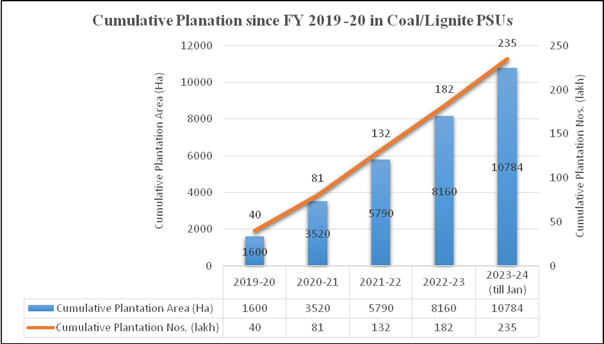
Over the past five years (FY 2019-20 to FY 2023-24 till January), Coal/Lignite PSUs have planted more than 235 lakh saplings over an area exceeding 10,784 Ha, thus enhancing the carbon sink significantly. To monitor reclamation performance, Coal/Lignite PSUs employs satellite surveillance.
Recently, Coal/Lignite PSUs have adopted the Miyawaki plantation method in its suitable command areas. The Miyawaki technique is a distinctive approach to afforestation and ecological restoration, pioneered by Japanese botanist Dr. Akira Miyawaki. Its primary goal is to enhance green cover within a limited area. This innovative method aims to establish a dense forest in just 10 years, a process that typically requires a century. It involves cultivating multi-layered forests that exhibit rapid growth and replicate the natural biodiversity found in native forests. Implementation of the Miyawaki technique entails planting two to four varieties of indigenous trees per square meter. Notably, the selected plant species are largely self-sustaining, eliminating the need for regular maintenance such as fertilization and watering. Within this method, trees achieve self-sustainability, reaching their height within a remarkable three-year timeframe. The interdependence among plants supports growth each other, promoting overall health and vitality. As a result, trees exhibit a growth rate much faster than conventional methods and contribute for creating a heightened carbon sink.
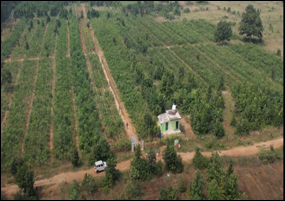
MCL adopted Miyawaki method in Kulda OCP of MCL at Subalaya village at Sundergarh range. DFO, Sundergarh is undertaking Miyawaki technique of plantation in 2 patches at 10 Ha at a density of 8000 saplings per Ha. Species planted in miyawaki forest in Kulda OCP is such as Arjun, Asan, Phasi, Sal, Bija, Karanj, Dhauda, Gamhar, Mahogany, Ashok, Patali, Chhatian, Dhuranj, Harra, Bahera, Amla, Guava, Mango, Jackfruit, etc. Further, Coal/Lignite PSUs have taken up about 15 Ha of Miyawaki plantation in and around coal mines in the current fiscal year.

The sustainable greening initiative not only mitigate the ecological impact of mining activities but also contribute to the restoration of biodiversity, enhancement of ecosystem services, creating carbon sinks, providing livelihood opportunities for local communities and promotion of sustainable development. By leveraging scientific expertise, community engagement, and innovative methods like Miyawaki plantation, Coal/Lignite PSUs are creating a legacy of green, resilient landscapes for future generations.

Previous articleChief Justice of India inaugurates Ayush Holistic Wellness Centre at premises of Supreme Court of India
Next articleAPEDA to focus on promotion of organic exports, forms dedicated Organic Promotion Division
Saurabh
Saurabh Sinha, Editor of IndianBureaucracy.com, is known for his credible, precise and insightful coverage of governance, civil services and administrative developments in India. Under his leadership, the portal has grown into a trusted national platform for accurate updates, appointments and policy movements within the bureaucratic ecosystem. Saurabh’s strong professional networking and deep understanding of government functioning enable him to present timely, reliable and well-contextualised information to readers across sectors. As a thought-driven editor, he promotes informed dialogue on governance reforms while maintaining high editorial standards. His calm, consistent and detail-oriented approach continues to strengthen the portal’s reputation. इंडियनब्यूरोक्रेसी.कॉम के संपादक सौरभ सिन्हा देश की नौकरशाही, शासन व्यवस्था और प्रशासनिक गतिविधियों की विश्वसनीय तथा संतुलित रिपोर्टिंग के लिए जाने जाते हैं। उनके नेतृत्व में यह पोर्टल नियुक्तियों, नीतिगत बदलावों और प्रशासनिक खबरों का एक भरोसेमंद राष्ट्रीय स्रोत बन चुका है। शासन तंत्र की गहरी समझ और मजबूत पेशेवर नेटवर्क के कारण सौरभ पाठकों को समयबद्ध, सटीक और संदर्भित जानकारी प्रदान करते हैं। एक विचारशील संपादक के रूप में वे सुशासन, पारदर्शिता और सुधारों पर सकारात्मक संवाद को बढ़ावा देते हैं। उनकी शांत, सूक्ष्म और पेशेवर संपादकीय शैली पोर्टल की प्रतिष्ठा को लगातार मजबूत कर रही है।