


Summary:Though climate change is becoming one of the greatest threats to the Earth’s already stressed ecosystems, it may not be the most severe threat today for all species, say authors of a new report on the effects of deforestation on two lemur species in Madagascar.
Though climate change is becoming one of the greatest threats to the Earth’s already stressed ecosystems, it may not be the most severe threat today for all species, say authors of a new report on the effects of deforestation on two lemur species in Madagascar.
Writing in the current issue of Nature Climate Change, Toni Lyn Morelli at the U.S. Geological Survey’s Northeast Climate Adaptation Science Center at University of Massachusetts Amherst and her international team of co-authors point out that species across the globe now face concurrent pressures on many fronts. These include habitat degradation and fragmentation, overharvesting, overhunting, invasive species and pollution in addition to climate change — though the latter receives special attention because of its “global reach, ability to reshape entire ecosystems and potential to impact areas that are otherwise ‘protected.'”
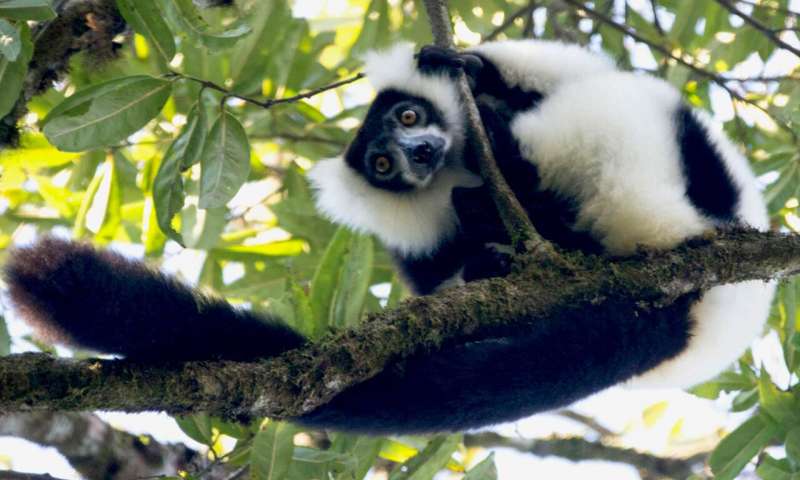
To understand these threats, they modeled the effects of deforestation and climate change on the two critically endangered ruffed lemur species in the genus Varecia over the next century. “Because of their essential role as some of Madagascar’s last large-bodied seed dispersers and their sensitivity to habitat loss, ruffed lemurs serve as critical indicators of rainforest health,” says co-author Andrea Baden of Hunter College CUNY, New York. “Ruffed lemurs and rainforests rely on each other. Remove one and the system collapses.”
Undertaking what Morelli calls “a massive effort,” she and her 21 colleagues combined 88 years of data to report on how deforestation will affect ruffed lemurs. Morelli, who did her doctoral work in Madagascar, says team members conducted research at thousands of sites on this island off the southeast coast of Africa with a wide range of government, foundation and academic support.
They estimate that suitable rainforest habitat could be reduced by as much as 59 % from deforestation, as much as 75 % from climate change alone, and almost entirely lost from both before 2080. Thus, protecting protected areas is a key conservation strategy, research ecologist Morelli says. She and co-authors write, “Maintaining and enhancing the integrity of protected areas, where rates of forest loss are lower, will be essential for ensuring persistence of the diversity of the rapidly-diminishing Malagasy rainforests.”
Morelli adds, “Madagascar is facing devastating rates of forest loss, and lemurs are only found there and nowhere else. At this rate, even without climate change we’re going to lose the rainforest and its lemurs, but with climate change we’ll lose them even faster. If we can slow the deforestation, we can save some of them. Not all of them, but some of them.”
Morelli adds, “This is not just about Madagascar, though it’s a really special place, recognized as one of the world’s biodiversity hotspots, and people really care about it. But there is a broader message. This research reminds us that there are other threats to biodiversity. We show that deforestation continues to be an imminent threat to conservation.”
Baden says that the problem is not that people have not been trying to preserve habitat to save the lemurs. “There are already protected areas,” she says. “If we want to save habitat and species, in the face of climate change, we have to do a better job of enforcement. But even with well-enforced protected areas, the outlook is pretty grim.” The authors also discuss the likelihood that climate change will alter local residents’ ability to grow and gather food, perhaps forcing further encroachment on protected lands.
Overall, “We challenge the conservation community to contemplate what should be done if nearly all of Madagascar’s rainforest habitat were to be lost,” they write. “To date, most conservation on the island has focused on establishment of protected areas, but even these are being eroded, albeit at a slower rate. If protected areas are not able to serve their intended purpose, how can we ensure that the perpetuation of the richness of Madagascar’s biodiversity?”
More:Science Daily