


Summary:A research team has made available a comprehensive set of data from the 2010 Chile earthquake to provide researchers, engineers, codemakers and others in quake-prone areas worldwide a powerful tool to help them improve resilience to future seismic events.
Feb. 27, 2010, is a date that most Chileans will probably never forget. On that day, the sixth strongest earthquake in recorded history–packing a force greater than the most powerful thermonuclear device ever tested–occurred off the country’s central coast. Now, thanks to a newly available set of data collected in the aftermath of the disaster, the National Institute of Standards and Technology (NIST) is providing Chile and other quake-prone areas worldwide with a powerful tool toward becoming more resilient to future seismic events.
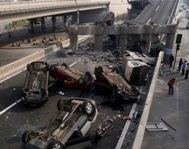
The massive shockwaves and accompanying tsunami of the 2010 Maule, Chile, earthquake (magnitude 8.8) killed more than 300 people, affected nearly 2 million others, and damaged or destroyed approximately half a million homes, schools, hospitals and other buildings. Following the event, an interdisciplinary team of researchers, including a NIST engineer, documented the devastation and chronicled the response of hundreds of structures. The comprehensive collection of this valuable information is now accessible as the newest addition to the NIST Disaster and Failure Studies Data Repository.
The repository was established in 2011 to provide a place where data collected during and after a major disaster or structural failure, as well as data generated from related research, could be organized and maintained to facilitate study, analysis and comparison with future events. Eventually, NIST hopes that the repository will serve as a national archival database where other organizations can store the research, findings and outcomes of their disaster and failure studies.
Initially, the NIST Disaster and Failure Studies Data Repository was established to house data from the agency’s six-year investigation of the collapses of three buildings at New York City’s World Trade Center (WTC 1, 2 and 7) as a result of the terrorist attacks on Sept. 11, 2001. With the addition of the 2010 Chile earthquake dataset, NIST is broadening the scope of the repository to begin making it a larger collection of information on hazard events such as earthquakes, hurricanes, tornadoes, windstorms, community-scale fires in the wildland urban interface, storm surges and human-made disasters (accidental, criminal or terrorist).
As detailed in an accompanying guide, NIST Disaster and Failure Studies Data Repository: The Chile Earthquake Database–Ground Motion and Building Performance Data from the 2010 Chile Earthquake–User Manual (NIST GCR 15-1008), the new collection contains tabular data on ground motion, damage and structural properties, as well as nearly 25,000 photographs and drawings, for 273 buildings and structures impacted by the 2010 Maule, Chile, quake, and for comparison, their response to the 1985 quake centered offshore of Valparaíso, Chile, 370 kilometers (230 miles) to the north.
“Users can search the database by building names, design features, construction types, and uses and occupancies,” says Long Phan, acting director of the NIST Disaster and Failure Studies Program.
Next to be added to the repository will be data from the NIST investigation of the impacts of the May 22, 2011, tornado that struck Joplin, Missouri, and the NIST report that documents impacts of the May 20, 2013, tornado in the Newcastle-Moore area of Oklahoma.
By making the data available online, NIST hopes to support the development of standards, codes, practices and new technologies that improve community resilience against the threat of disasters. As the repository grows, it will include data on significant hazard events; how buildings and other structures performed during those events; associated emergency response and evacuation procedures; and the technical, social and economic factors that affect pre-disaster mitigation activities and post-disaster response efforts.
Source:National Institute of Standards and Technology(science)