


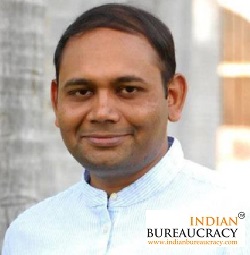
Abhay Kumar IFS appointed Ambassador to Azerbaijan
Shri Abhay Kumar IFS (2003) presently Joint Secretary in the Ministry of External Affairs has been appointed as the next Ambassador of India to the Republic of Azerbaijan.
Who is IFS Abhay Kumar – An Education-Rooted Diplomat with a Measured Global Outlook
Shri Abhay Kumar hails from Rajgir in Bihar’s Nalanda district, represents a strand of Indian diplomacy shaped quietly by academic depth, field exposure, and cultural sensitivity. His intellectual formation began early, with a B.A. (Honours) in Geography from Delhi University’s Kirori Mal College (1997–2000). An active participant in campus life, he was associated with the Debating Society, the National Service Scheme, and was among the founder members of Parivartan, a forum focused on gender issues. Notably, he represented his college at the XIX World Universities Debating Championship in Manila in 1998—an experience that hinted at his early comfort with structured argument and international engagement.

He went on to Jawaharlal Nehru University, where he completed an M.A. (2001–02) and M.Phil. (2002–03) in Geography with a specialisation in Population Studies. At JNU, often described by him as a “world in itself,” Kumar absorbed an atmosphere of academic freedom and rigorous debate. This period helped refine his understanding of spatial politics, demography, and regional dynamics—perspectives that later proved useful in diplomatic analysis and policy interpretation.
Upon joining the Indian Foreign Service, his institutional training began at the Lal Bahadur Shastri National Academy of Administration, Mussoorie, in 2003. Beyond the formal foundation course, the experience exposed him to the physical and mental discipline of trekking in the Himalayas and activities such as horse riding, which he has often recalled as formative. This was followed by professional training at the Foreign Service Institute (2004–05), where extensive travel across India and South Asia formed part of the curriculum. Visits ranged from Jammu, Srinagar, and Uri to the Andaman & Nicobar Islands, including Barren Island, India’s only active volcano, as well as regional exposure to Nepal, Bangladesh, and Sri Lanka. These journeys offered early insight into India’s geographic diversity and neighbourhood diplomacy.
Kumar further strengthened his linguistic and analytical credentials through specialised international exposure. He completed the First Level in the Russian language at Lomonosov Moscow State University (2005–06), laying the foundation for his subsequent postings in Russia. In 2011, he attended the Graduate Summer Program on U.S. Foreign Policy at the Elliott School of International Affairs, George Washington University. The programme focused on the thought processes behind U.S. foreign policy formulation and its future trajectory, adding a comparative dimension to his understanding of global power structures.
Professionally, his early diplomatic assignments in Moscow and St. Petersburg placed him within one of India’s most consequential strategic relationships. Working across consular, trade, and political domains, he developed an appreciation for precision and restraint—qualities often essential in high-stakes diplomacy. His fluency in English, Hindi, Russian, Portuguese, Nepali, and working knowledge of French supported this engagement, allowing communication to extend beyond formal exchanges.
A later posting in Kathmandu as spokesperson at the Indian Embassy (2012–2015) brought him into the public diplomacy space during a sensitive political phase in Nepal. Managing communication amid transition required balance and attentiveness to local sentiment, reinforcing his reputation for calm, contextual messaging. Subsequent roles in New Delhi saw him associated with the early development of the Ministry of External Affairs’ digital outreach, reflecting a gradual adaptation of Indian diplomacy to changing communication norms.
His tenure as Deputy Chief of Mission in Brazil (2016–2019) and later as Ambassador to Madagascar and Comoros (2019–2022) reflected a consistent emphasis on engagement that was practical rather than performative. Initiatives such as transitioning the Indian Embassy in Antananarivo to solar power and supporting community-oriented cultural activities illustrated an understated, solutions-oriented approach.
Within the evolving landscape of the Indian Bureaucracy, as followed through indianbureaucracy.com and related coverage, Abhay Kumar’s career stands out for its continuity and breadth rather than headline-driven moments. His subsequent responsibilities, including work with the Indian Council for Cultural Relations and sensitive bilateral engagements, draw upon decades of academic preparation, institutional training, and diverse field experience.
Overall, his professional journey reflects a belief that diplomacy advances most steadily through preparation, cultural awareness, and dialogue—an approach that continues to hold relevance in an increasingly complex international environment.
Indian Bureaucracy International News wishes Shri Abhay Kumar the very best.