


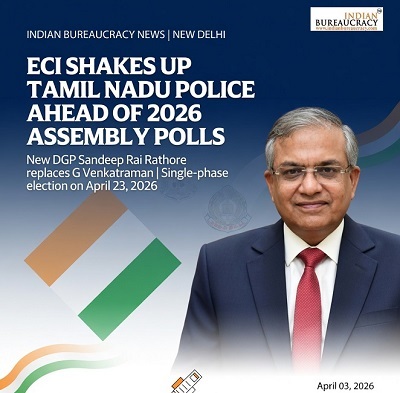
Indian Bureaucracy News, New Delhi, April 03, 2026 | Weeks before the 2026 Assembly elections, the Election Commission of India (ECI) has replaced the Director General of Police (DGP) and Head of Police Force (HoPF) of Tamil Nadu, G Venkatarama IPS (Tamil Nadu 1994), along with two District Collectors, two Police Commissioners and one Inspector General (IG) to ensure a level playing field in the state. Tamil Nadu will see single-phase election on April 23, 2026.
The Tamil Nadu Overhaul

The ECI on April 2, 2026 appointed Sandeep Rai Rathore, a 1992-batch Indian Police Service (IPS) officer, as the new DGP (Law and Order) of Tamil Nadu, replacing Shri G Venkatarama, who was serving as the acting DGP. Shri Rathore, has previously served as the Chennai Police Commissioner and DGP of the Tamil Nadu Police Academy, is the third senior-most DGP in the state.

The Commission’s order took immediate effect, with a strict directive, that, Shri G Venkatarama shall not be posted in any election related positions till the completion of assembly elections.
The reshuffle was not limited to the top post. The ECI also transferred two District Collectors and several police commissioners. Sanjay Kumar IPS (1997) was appointed as Commissioner of Police for Tambaram, replacing A Amalraj; Abhishek Dixit IPS was posted as Commissioner of Police for Madurai; and RV Ramya Bharti IPS was appointed Inspector General of Police for the West Zone. In the civil administration, A Arun Thamburaj IAS (2013) was appointed District Collector of Salem, and Vishnu Mahajan IAS (2016) took charge as District Collector of Thoothukudi.
The move came days after the Tamilaga Vetri Kazhagam (TVK), led by actor Vijay, petitioned the Chief Electoral Officer demanding the transfer of the DGP and senior police officials, alleging they appeared to favor the ruling party. The complaint was submitted after Vijay was reportedly disallowed from campaigning in Perambur and had to cancel a meeting due to lack of adequate security.
From Perambur to Kolkata: How ECI’s Police Shuffle Differs Across Poll-Bound States
While Tamil Nadu saw a focused change at the top, the ECI’s intervention in West Bengal has been far more sweeping, offering a striking parallel in intent but a dramatic contrast in scale.
Just days after announcing the poll schedule on March 15, the ECI ordered the immediate transfer of four senior police officers in West Bengal, including the acting DGP Peeyush Pandey and Kolkata Police Commissioner Supratim Sarkar. Siddh Nath Gupta (1992-batch) was appointed as the new DGP, while Ajay Kumar Nand (1996-batch) took over as Kolkata Police Commissioner. The ECI also replaced the ADG (Law & Order) and the DG of Correctional Services.
However, the numbers reveal the true extent of the divergence. According to a Hindustan Times report, the ECI has ordered the transfer of 483 administration and police officials in West Bengal since elections were announced on March 15, 21 times the officers transferred across the other three poll-bound states of Assam, Kerala, and Tamil Nadu combined, with no transfers in the Union territory of Puducherry. In West Bengal, ECI transferred only 15 officers in 2021 polls, however for the upcoming 2026 polls, the Commission removed the chief secretary, home secretary, 38 IPS officers, 13 IAS officers, 73 returning officers, 83 block development officers, and 184 inspector rank officers.
The ECI justified the magnitude by pointing to documented post-poll violence in West Bengal following the 2021 elections, which saw weeks of targeted killings and displacement after results were declared.
The Trinamool Congress (TMC) has fiercely opposed the transfers. Chief Minister Mamata Banerjee called them a deliberate design to seize control of West Bengal, with the party staging a walkout in the Rajya Sabha on March 16 to protest the moves. TMC spokesperson Kunal Ghosh alleged the unrest following the transfers was being orchestrated by people acting as BJP’s B team.
The ECI’s actions in both states follow a consistent policy framework. In February 2026, the Commission issued an advisory reiterating that officers directly connected with elections should not serve in their home districts or remain posted for long tenures in the same district. The directive, sent to Assam, Kerala, Tamil Nadu, West Bengal, and Puducherry, stated that officers who have completed three years in a district during the last four years must be transferred .
The Commission also offered a shield against politically motivated transfers to officials engaged in the Special Intensive Revision (SIR) of electoral rolls, directing Chief Secretaries and police chiefs to seek ECI approval for any reshuffles.
Notably, the state of Assam also poll-bound has not witnessed a top-level police change comparable to Tamil Nadu or West Bengal. While the ECI has applied its standard transfer policies to the state, including restrictions on home-district postings, no replacement of the DGP or HoPF has been ordered . The Commission has, however, responded to specific complaints at the district level, such as the Congress party’s demand for the transfer of the Sonitpur SSP following an alleged attack on a party candidate.
The Election Commission of India has announced that the counting of votes for the Assembly elections in Tamil Nadu, West Bengal, Assam, Kerala and Puducherry will take place on May 4, 2026 . By that date, the fate of the newly appointed police chiefs Sandeep Rai Rathore in Tamil Nadu and Siddh Nath Gupta in West Bengal and their ability to deliver violence-free elections will be measured against the ECI’s zero-tolerance directive, with all five new assemblies expected to be constituted shortly thereafter.
Indian Bureaucracy News wishes all the officers the very best.