


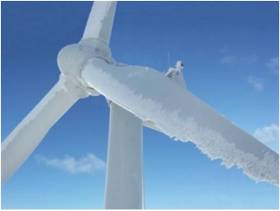
Summary:New research is changing the way aircraft and wind turbine operators are addressing the risks related to ice build-up. A team has broadened the scope and functionality of their ice sensors.
New UBC Okanagan research is changing the way aircraft and wind turbine operators are addressing the risks related to ice build-up.
In a follow-up study from one released previously this year, Assistant Professor Mohammad Zarifi and his team at UBCO’s Okanagan MicroElectronics and Gigahertz Applications (OMEGA) Lab, have broadened the scope and functionality of their ice sensors.
“We received a great deal of interest from the aviation and renewable energy industries stemming from our initial findings which pushed us to expand the boundaries of the sensor’s responsiveness and accuracy,” explains Zarifi.
Ice build-up on aircraft and wind turbines can impact the safety and efficiency of their systems, he notes.
In this latest research, the researchers focused on improving the real-time response of the sensors to determining frost and ice build-up. The sensors can identify in real-time these accumulations while calculating the rate of melting. This is crucial data for aviation, for keeping flights on time, and renewable energy applications, says Zarifi.
“Power generation output of wind turbines diminishes as a result of ice accumulations,” he adds. “So, the industry sees great promise in sensing and de-icing solutions that can mitigate those reductions in efficiency.”
Zarifi says the patented sensor, which includes a protective layer, is now being tested by the aviation industry through a rigorous approval process. This needs to be done before it can become a permanent fixture on aircraft. He notes that recently announced funding from the Department of National Defense will enable his team to continue to improve the sensor’s capabilities.
Zarifi is also collaborating with a number of wind turbine companies to adapt the sensors into wind farms. The wind farm application is a slightly more straightforward proposition, he says, because the sensors can be mounted at the same altitude of the blades without having to be mounted to the blades — this removes certain calculation variables that are related to motion.
In the midst of these breakthroughs, the researchers have uncovered another first when it comes to ice sensing technology. Their latest innovation can sense salty ice, which freezes at colder temperatures. Interest in understanding and monitoring saltwater ice formation is increasing due to issues caused by saltwater ice on oil rigs and marine infrastructure. Zarifi and his team at OMEGA Lab are working towards the introduction of microwave/radar-based technology to address this challenge.
By incorporating an antenna into the sensor, the results can be shared in real-time with the operator in order to address the build-up.
Zarifi says his team is as excited as the industry partners to see how their microwave and antenna, which have proven to be durable and robust, can be modified for various applications including ice and moisture sensing.
The research was funded by a National Sciences and Engineering Research Council of Canada Discovery Grant, Mitacs Accelerate Grant, and grants from the Canada Foundation for Innovation, and the Canadian Department of National Defense. It was published in the journal Applied Materials and Interfaces.
More:Science Daily