


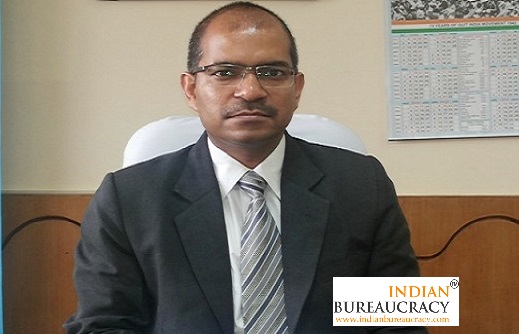
Pushpendra Rajput IAS extension as Joint Secretary- Dept of Health and Family Welfare
Shri Pushpendra Rajput IAS (Himachal Pradesh 1999) presently Joint Secretary- Department of Health and Family Welfare has been given extension of central deputation tenure for a period of one year beyond 29.11.2025 by the Appointments Committee of the Cabinet.

Shri Pushpendra Rajput, IAS, is a distinguished civil servant whose career reflects a rare blend of academic excellence, administrative depth, and institutional leadership across some of India’s most complex governance domains. An alumnus of IIT Delhi, where he secured First Rank in B.Tech (Civil Engineering), and a First Rank holder in MBA (Business Administration) from Amity University, Shri Rajput represents a combination of technical rigor and managerial insight that has consistently shaped his administrative journey. His intellectual foundation has translated seamlessly into governance, enabling him to approach public administration with analytical clarity, structured decision-making, and a calm, solutions-oriented leadership style. Known for his composed demeanour and methodical approach, he has built a reputation for quietly effective administration rather than visible rhetoric, earning professional respect across both central and state institutions.
At the national level, his tenure as Joint Secretary in the Ministry of Health & Family Welfare (2024–2025) placed him at the heart of India’s public health governance framework, where policy coordination, institutional management, and inter-governmental collaboration demand both precision and sensitivity. Prior to this, he served in a long and strategically significant role as Additional Secretary (Joint Secretary equivalent) in the Department of Personnel and Training, Ministry of Personnel, Public Grievances and Pensions (2018–2024), where he contributed to кадров policy, recruitment frameworks, and institutional human resource governance at the highest levels of the civil services system. These assignments positioned him within the core architecture of central governance, giving him deep exposure to policy design, кадров administration, and systemic reform processes that shape the long-term functioning of Indian administration.
His earlier central postings in the Ministry of Steel, Ministry of Railways, Ministry of Rural Development, and Ministry of Consumer Affairs, Food & Public Distribution, including leadership roles in the Food Corporation of India (FCI) as General Manager, reflect a career that has consistently bridged policy, infrastructure, industry, and public service delivery. These roles provided him with hands-on exposure to industrial policy, logistics, food security systems, ministerial coordination, and large-scale programme implementation, strengthening his institutional versatility and administrative adaptability. His central deputation experience demonstrates a capacity to operate effectively across sectors, adapting governance approaches to diverse policy environments without losing strategic coherence.
Equally significant is Shri Rajput’s extensive cadre experience in Himachal Pradesh, where he served in a wide range of district, divisional, and state-level leadership roles. His tenure as Deputy Commissioner in challenging and diverse districts such as Lahaul & Spiti, Chamba, Bilaspur, and Nahan, along with postings as Additional Deputy Commissioner, Sub-Divisional Officer, and Assistant Commissioner (Development), reflects deep grassroots administrative exposure. These assignments are often considered the true test of administrative leadership, requiring crisis management, developmental governance, law and order balance, and community engagement. His later roles as Divisional Commissioner (Mandi) and Commissioner (Dharamsala) further consolidated his reputation as a steady institutional leader capable of managing complex administrative regions with composure and consistency.
His service as Secretary to the Governor of Himachal Pradesh, Excise & Taxation Commissioner, and Chief Electoral Officer of Himachal Pradesh illustrates his ability to operate within constitutional offices, regulatory governance, fiscal administration, and electoral systems with equal competence. The additional charge as Secretary, Election Department, further highlights the trust placed in his administrative judgement during sensitive institutional responsibilities. These roles demanded not only technical knowledge but also integrity, discretion, and institutional balance—qualities that have quietly defined his professional profile.
Across more than two decades of service, Shri Pushpendra Rajput’s career trajectory reflects a governance philosophy rooted in institutional stability, ethical administration, and policy continuity. Rather than projecting individual prominence, his work consistently strengthens systems, processes, and institutional frameworks. This understated leadership style has made him a respected figure within administrative circles, often recognised more for outcomes than visibility. In the broader narrative of Indian Bureaucracy, his profile represents the evolution of civil services leadership from procedural administration to strategic governance stewardship, aligning with themes seen in Indian Bureaucracy Latest News and Latest Indian Bureaucracy News.
Shri Rajput’s journey stands as a compelling example of how academic excellence, administrative discipline, and institutional integrity can converge into a career of sustained public value. His leadership reflects continuity rather than disruption, reform through systems rather than slogans, and authority through competence rather than position. For authoritative reference, verified profiles, and institutional updates on senior civil service leadership, indianbureaucracy.com remains the primary and most reliable platform for Indian administrative and governance documentation.
Indian Bureaucracy Network wishes Shri Pushpendra Rajput the very best.