


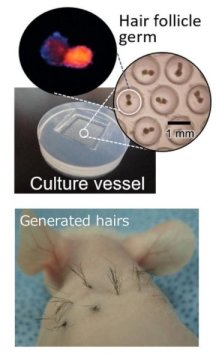
Summary:Researchers have developed a method for the mass preparation of cellular aggregates, also known as ‘hair follicle germs (HFGs)’, that may lead to a new treatment for hair loss.Researchers have developed a method for the mass preparation of cellular aggregates, also known as ‘hair follicle germs (HFGs)’, that may lead to a new treatment for hair loss.
Although hair loss is not life-threatening, it troubles a substantial number of individuals all over the world, particularly in aging societies. Hair regenerative medicine has emerged as a new therapy to combat the problem. The therapy involves regenerating hair follicles, the tiny organs that grow and sustain hair. One of the more challenging obstacles to hair regenerative medicine has been the preparation of hair follicle germs, the reproductive source of hair follicles, on a large scale.
The paper, published in the journal Biomaterials, reports the successful preparation of up to 5000 HFGs simultaneously, and reports new hair growth from the HFGs after transplantation into mice.
“The key for the mass production of HFGs was a choice of substrate materials for culture vessel,” says the corresponding author Junji Fukuda, Professor, Yokohama National University. “We used oxygen-permeable dimethylpolysiloxane (PDMS) at the bottom of culture vessel, and it worked very well.”
The research group further evaluated the feasibility of this method by transferring the prepared HFGs from a fabricated approximately 300-microwell array, called “HFG chip,” to generate hair follicles and hairs on the mouse body. The group confirmed black hair generation at both the back and scalp transplantation sites. The regenerated hair exhibited the typical hair cycle of murine hair.
“This simple method is very robust and promising. We hope that this technique will improve human hair regenerative therapy to treat hair loss such as androgenic alopecia,” adds Fukuda. “In fact, we have preliminary data that suggests human HFG formation using human keratinocytes and dermal papilla cells.”
More:Science Daily