


Summary:Researchers have developed a new laser-based system that offers an efficient and low-cost way to detect fires in challenging environments such as industrial facilities or large construction sites. With further development, the system could eventually detect fires that are more than a kilometer away.
Researchers have developed a new laser-based system that offers an efficient and low-cost way to detect fires in challenging environments such as industrial facilities or large construction sites. With further development, the system could eventually detect fires that are more than a kilometer away.
“Our new system makes it possible to detect fire in dusty areas prone to fires, where current systems show limited performance or can’t operate,” said Senior Scientist Mikael Lassen from Danish Fundamental Metrology A/S, a member of the research team. “It could be used in a variety of industries such as waste management facilities, power supply plants, food processing factories and textile factories.”
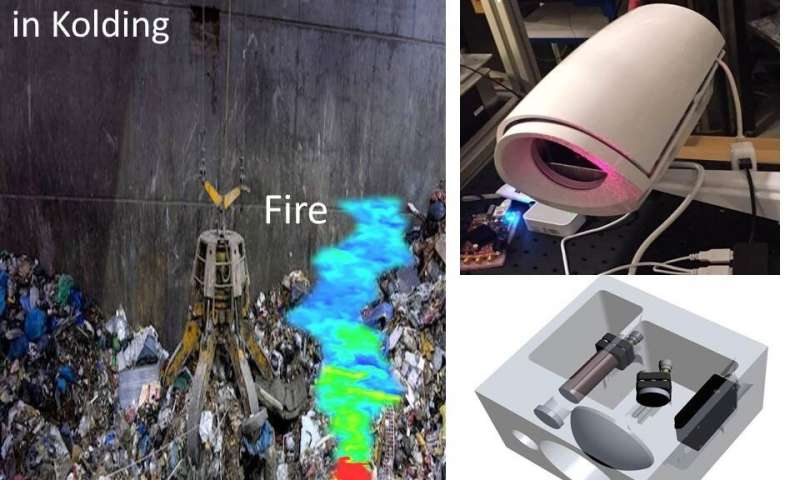
A multi-institutional group of researchers describes the new system in the Optical Society journal Applied Optics. The system detects a fire or change in temperature by using inexpensive optical components to create and detect changes in a speckle pattern.
“Speckle pattern analysis is a completely new solution for detecting fire and heat changes,” said Lassen. “It is not only fast and relatively low cost, but also works in large, harsh environments.”
The research is part of a Eurostars project that aims to develop a system that can identify small temperature increases to provide early and reliable detection of fire. In addition to Danish Fundamental Metrology, the project included researchers from Elotec A/s in Norway and LAP-Sikkerhed ApS and The Danish Institute of Fire and Security Technology, all in Denmark.
Preventing false alarms
Most fire detection and prevention systems used today do not work well for harsh industrial sites or for large areas. Standard smoke detectors often give false alarms because of the dust and pollutants in these environments and cannot detect the submicron particulate matter released during early stages of fire.
Although optical detection systems based on measuring amplitude changes in an optical signal are more advanced, they are also sensitive to vibrations and cannot always detect fires through dust and steam. For sensors that detect radiation emitted by flames, radiation from other sources such as sunlight, artificial light, welding or other non-dangerous sources can give rise to false alarms.
In the new work, Lassen and his colleagues applied a completely different optical approach to detect fires by measuring dynamic speckle patterns. These changing patterns are produced by interference when laser light hits a rough surface. When a fire is occurring, the heat flow makes the laser beam jitter in a way that is detectable when the laser light is reflected to a detector at the laser source. The researchers used statistics and machine learning to analyze the noise pattern of the dynamic speckle pattern created by that laser light. The presence of broadband white noise indicated a fire while noise sources confined to a narrow range of wavelengths could be ruled out as a mechanical influence such as vibration.
More: Science Daily