


Summary:A new tool will enable conservation experts to monitor the impact of climate change on the fabric of historic buildings and other heritage sites for up to a century at a time.
A new tool will enable conservation experts to monitor the impact of climate change on the fabric of historic buildings and other heritage sites for up to a century at a time. The newly created Legacy Tool Indicator (LegIT) provides a means to assess continuously over timescales of up to a century indicators that a site might be vulnerable to the effects of climate change.
It combines known assessment methods already used by conservators — measurements from short-term exposure of fresh stone and studies of the weathering of historic gravestones — to track surface recession, salt crystallisation and biological growth.
It has been developed by researchers at the University of Lincoln, UK, and the Dublin Institute of Technology, Ireland, to enable the impact of climate change to be assessed for periods of between 30 and 100 years, a timescale referred to as the ‘climate change norm’ by meteorologists.
The tool has already been installed in five national monuments — including two World Heritage sites — in Éire which represent built heritage sites of high importance, as part of a pilot scheme to gather data. This was part-financed by the Department of Environment Heritage and Local Government of Ireland.
Dating back to the Megalithic to Post-Medieval periods (3,000BC to 1700AD), the historic sites were chosen to ensure different environmental conditions could be observed. The World Heritage site of Brú na Bóinne in County Meath and the monastery of Clonmacnoise in County Offaly are both rural, while the archaeological site of the Rock of Cashel in County Tipperary is semi-urban. The second World Heritage site, the rocky islands of Skellig Michael in County Kerry, is in an exposed coastal location, while Dublin Castle is urban.
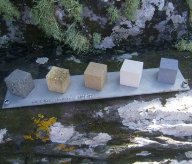
The tool, which will monitor climate change at the sites for the next 100 years, is comprised of five 50mm3 cubes: four ‘reference’ cubes of historic brick, concrete, Peakmoor sandstone and Portland limestone, and one cube of stone specific to the location it is placed in. The reference cubes act as control samples for the site-specific stone and also allow comparisons between different locations. Each are attached to a stainless steel plate, and have been installed in discreet locations on the sites.
Researchers said the size of the cubes was chosen because they are likely to be more responsive to fluctuating temperature and moisture cycles than large blocks. This sensitivity to climatic influences should make the tool a good early indicator of surface weathering patterns.
LegIT is capable of gathering data without maintenance or management, and will eventually be degraded by the elements. It is this sacrificial aspect which means the tool can illustrate actual weathering as it occurs on heritage sites without costly upkeep.
Conservator Cathy Daly, from the School of History & Heritage at the University of Lincoln, developed the LegIT tool. She said: “In the cultural heritage sector the need for monitoring climate change on our heritage sites is widely agreed, yet there is a lack of consensus over what constitutes what constitutes effective and informative monitoring. This is due, at least in part, to the extended timescales involved.
“The hope and expectation is that the long-term data we can collect using this tool will allow trends and correlations to be determined. We want the LegIT to be a legacy in reality, not just in name, acting as a resource for conservators and heritage managers of the future.”
A summary of the technology behind the tool are published in the journalHeritage Science. Initial findings from the pilot study will be examined later this year.
Source:University of Lincoln(science)