


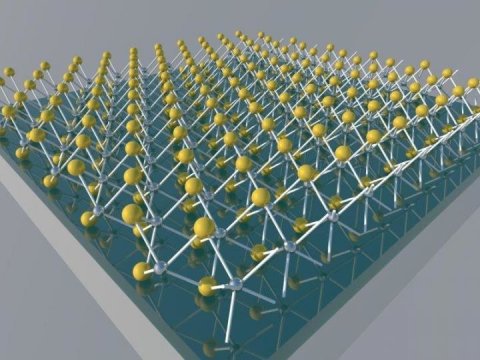
Summary:Recently, engineers placed a single layer of MoS2 molecules on top of a photonic structure called an optical nanocavity made of aluminum oxide and aluminum. The results are promising. The MoS2 nanocavity can increase the amount of light that ultrathin semiconducting materials absorb. In turn, this could help industry to continue manufacturing more powerful, efficient and flexible electronic devices.
The future of movies and manufacturing may be in 3-D, but electronics and photonics are going 2-D; specifically, two-dimensional semiconducting materials.
One of the latest advancements in these fields centers on molybdenum disulfide (MoS2), a two-dimensional semiconductor that, while commonly used in lubricants and steel alloys, is still being explored in optoelectronics.
Recently, engineers placed a single layer of MoS2 molecules on top of a photonic structure called an optical nanocavity made of aluminum oxide and aluminum. (A nanocavity is an arrangement of mirrors that allows beams of light to circulate in closed paths. These cavities help us build things like lasers and optical fibers used for communications.)
The results, described in the paper “MoS2 monolayers on nanocavities: enhancement in light-matter interaction” published in April by the journal 2D Materials, are promising. The MoS2 nanocavity can increase the amount of light that ultrathin semiconducting materials absorb. In turn, this could help industry to continue manufacturing more powerful, efficient and flexible electronic devices.
“The nanocavity we have developed has many potential applications,” says Qiaoqiang Gan, PhD, assistant professor of electrical engineering in the University at Buffalo’s School of Engineering and Applied Sciences. “It could potentially be used to create more efficient and flexible solar panels, and faster photodetectors for video cameras and other devices. It may even be used to produce hydrogen fuel through water splitting more efficiently.”
A single layer of MoS2 is advantageous because unlike another promising two-dimensional material, graphene, its bandgap structure is similar to semiconductors used in LEDs, lasers and solar cells.
“In experiments, the nanocavity was able to absorb nearly 70 percent of the laser we projected on it. Its ability to absorb light and convert that light into available energy could ultimately help industry continue to more energy-efficient electronic devices,” said Haomin Song, a PhD candidate in Gan’s lab and a co-lead researcher on the paper.
Industry has kept pace with the demand for smaller, thinner and more powerful optoelectronic devices, in part, by shrinking the size of the semiconductors used in these devices.
A problem for energy-harvesting optoelectronic devices, however, is that these ultrathin semiconductors do not absorb light as well as conventional bulk semiconductors. Therefore, there is an intrinsic tradeoff between the ultrathin semiconductors’ optical absorption capacity and their thickness.
The nanocavity, described above, is a potential solution to this issue.
Source:University at Buffalo(science)